


baseScribe Cap1 IVT Kit
High-yield in vitro transcription (IVT) synthesis of capped mRNA with superior quality and translation properties
| Size | Catalog No. | Price |
|---|---|---|
| 1 Kit / 20 Assays | BCK-IVT-CAP1-20 | € 840,00 |
Chemical Properties
-
Shelf Life
12 months unopened after receipt
-
Storage Conditions
– 20 °C
-
Physical State
kit system made of different components
-
CAS Number
n.a.
-
Preparation/Handling
please see user manual of the kit
Product Information
Reliable One‑Step Synthesis of Translationally Competent Cap1‑Capped mRNA
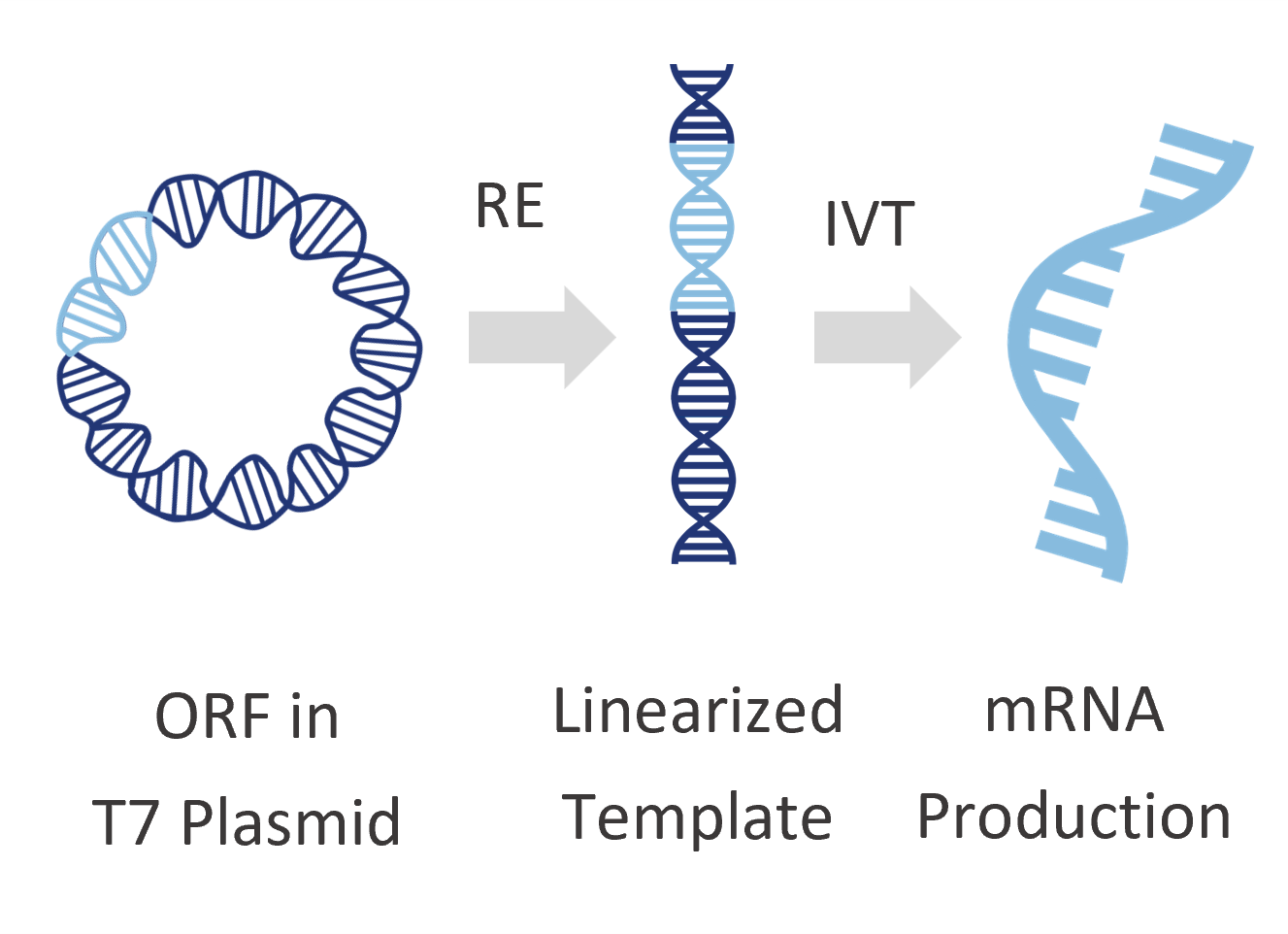
The baseScribe Cap1 IVT Kit is an optimized in vitro transcription (IVT) system for the robust production of Cap1‑capped mRNA from DNA templates containing a T7 promoter. Designed for reliability and ease of use, the kit provides high yields of high‑quality mRNA in a single co‑transcriptional reaction, ready for downstream applications in vitro or in vivo.
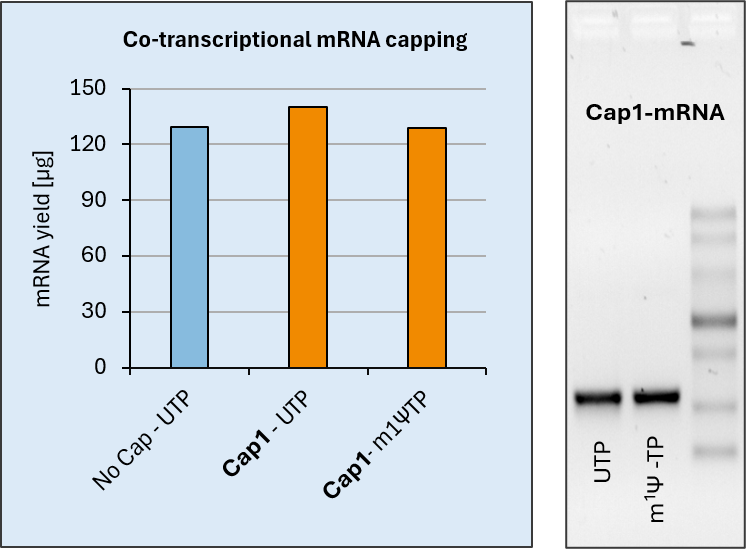
Fig.1: The baseScribe Cap1 IVT Kit from baseclick is perfectly suited for co-transcriptional Cap1-capping. The high-quality mRNA is ready to use for translation.
The kit supports transcription from linearized plasmid DNA or PCR‑derived templates and enables reproducible generation of translationally competent mRNA without the need for post‑transcriptional capping steps.
Optimized Enzyme System for Reliable RNA Synthesis
The performance of the baseScribe Cap1 IVT Kit is based on the same optimized enzymatic architecture described in baseclick’s IVT whitepaper. Key features include:
- a high‑performance, GMP‑grade T7 RNA polymerase engineered for efficient transcription,
- pyrophosphatase to remove inhibitory pyrophosphate and prevent premature reaction stalling,
- and a carefully balanced transcription buffer designed to support sustained enzyme activity.
- RNase inhibitor and DNase I for template removal
This combination enables robust transcription efficiency and reproducible RNA quality across different templates and production batches. A linear DNA control template is included to allow evaluation of RNA yield and integrity.
High Yield from Minimal DNA Input
Under optimized conditions, the IVT system delivers 140–180 µg RNA from 1 µg of linearized plasmid DNA or 200–500 ng PCR‑derived template per 20 µL reaction.
Each kit supports 20 standard IVT reactions, allowing efficient production of Cap1‑capped RNA from limited DNA input.
The high yield and small reaction volume make the kit suitable for applications requiring reliable RNA production without extensive scale‑up.
Co‑Transcriptional Cap1-Capping for Efficient Translation
The baseScribe Cap1 IVT Kit enables co‑transcriptional incorporation of a Cap1 structure, generating RNA with a native‑like 5′-cap during transcription. This integrated approach eliminates the need for post‑transcriptional capping steps and streamlines RNA production workflows.
The resulting Cap1‑capped RNA is suitable for downstream applications requiring translationally competent RNA.
Demonstrated RNA Quality and Homogeneity
RNA produced using the optimized IVT system shows:
- high integrity and homogeneity,
- well‑defined transcript bands in agarose gel analysis,
- and minimal formation of truncated by‑products.
These characteristics are a direct result of optimized enzyme ratios, nucleotide purity, and controlled reaction conditions as demonstrated in the IVT whitepaper.
Compatibility with Modified Nucleotides
The baseScribe Cap1 IVT Kit is fully compatible with the incorporation of modified uridine analogs, including:
- pseudouridine (Ψ),
- N1‑methylpseudouridine (m¹Ψ),
- 5‑ethynyl uridine (EU)
Full replacement of uridine with Ψ or m¹Ψ does not reduce RNA yield, while incorporation of EU leads to an expected yield reduction of approximately 50%. This enables the generation of Cap1‑capped RNA tailored for stability, reduced immunogenicity, or downstream chemical functionalization.
Scalable and Reproducible Performance
The IVT reaction conditions have been optimized for reproducibility and scalability, enabling consistent performance across multiple reactions. Concentrated enzyme formulations contribute to enhanced storage stability and batch‑to‑batch consistency.
Key Features and Benefits
- Co‑transcriptional synthesis of Cap1‑capped RNA
- High‑performance T7‑based IVT system
- 140–180 µg RNA per reaction from 1 µg DNA
- GMP‑grade enzymes and nucleotides
- Pyrophosphatase‑supported reaction performance
- Compatible with modified and clickable nucleotides
- Reproducible and scalable IVT performance
- Control template for performance verification included
Applications
- mRNA‑based protein expression studies
- Functional mRNA analysis in vitro and in vivo
- Development and optimization of modified mRNAs
- Chemical biology and RNA labeling workflows
For research use only.
LITERATURE
Synthetic mRNAs with superior translation and stability properties, A. Grudzien‑Nogalska et al., Methods Mol Biol. 2013;969:55-72.
Incorporation of Pseudouridine Into mRNA Yields Superior Nonimmunogenic Vector With Increased Translational Capacity and Biological Stability, K. Karikó et al., 2008, Mol. Ther., Vol. 16, p. 1833–1840.
N1-methyl-pseudouridine in mRNA enhances translation through eIF2α-dependent and independent mechanisms by increasing ribosome density, I. Svitkin et al., Nucleic Acids Research, Volume 45, Issue 10, 2 June 2017, Pages 6023–6036.
FAQ
-
What is the baseScribe Cap1 IVT Kit used for?
It is an in vitro transcription (IVT) system designed for the one‑step synthesis of Cap1‑capped, translation‑ready mRNA from T7 promoter–containing DNA templates.
-
Does the kit support both plasmid and PCR‑derived templates?
Yes. The system works with linearized plasmid DNA and PCR‑generated templates, enabling flexible workflow design.
-
What makes the kit different from standard IVT systems?
It integrates a co‑transcriptional Cap1‑capping mechanism, eliminating post‑transcriptional capping steps and ensuring native‑like 5′‑cap formation during transcription.
-
What enzymes are included in the kit?
The kit contains:
- High‑performance GMP‑grade T7 polymerase
- Pyrophosphatase to prevent pyrophosphate accumulation
- RNase inhibitor to protect transcripts
- DNase I for template removal
These components support robust, high‑integrity RNA synthesis.
-
How much RNA can I expect from one reaction?
Under optimized conditions in a standard 20 µL reaction, the kit yields:
- 140–180 µg mRNA per 1 µg linearized plasmid DNA
- High yields from 200–500 ng PCR‑derived template
-
Is the kit compatible with modified nucleotides?
Yes. The system supports full or partial substitution of uridine with:
- Pseudouridine (Ψ)
- N1‑methylpseudouridine (m¹Ψ)
- 5‑Ethynyl‑uridine (EU)
EU incorporation reduces yield (~50%) but allows for extended translation, however Ψ and m¹Ψ maintain a high RNA yield.
-
What downstream applications are supported?
The Cap1‑capped RNA is suitable for:
- mRNA protein expression studies
- In vitro and in vivo mRNA functional assays
- Development of chemically modified or stabilized mRNAs
- RNA labeling and chemical biology workflows
-
Does the kit include a control template?
Yes. A linear DNA control template is included to evaluate reaction performance and verify RNA integrity.
-
Is the produced mRNA translation‑competent?
Yes. The Cap1 structure, high RNA integrity, and optimized enzymatic ratios ensure fully translationally competent mRNA.
-
For what regulatory category is the kit intended?
The kit is intended for research use only.