


baseScribe Mod Cap1 IVT Kits for the Synthesis of Modified mRNAs
High-yield in vitro transcription (IVT) synthesis of imunosilent, capped mRNA with superior quality and translation properties
| Size | Catalog No. | Price |
|---|---|---|
| 1 Kit PSI / 20 Assays | BCK-IVT-CAP1-PSI-20 | € 955,00 |
| 1 Kit MPSI / 20 Assays | BCK-IVT-CAP1-MPSI-20 | € 970,00 |
Chemical Properties
-
Shelf Life
12 months unopened after receipt
-
Storage Conditions
– 20 °C
-
Physical State
kit system made of different components
-
CAS Number
n.a.
-
Preparation/Handling
please see user manual of the kit
Product Information
One‑Step Synthesis of Cap1-Capped Pseudouridine‑ or N1-Methylpseudouridine‑modified mRNAs
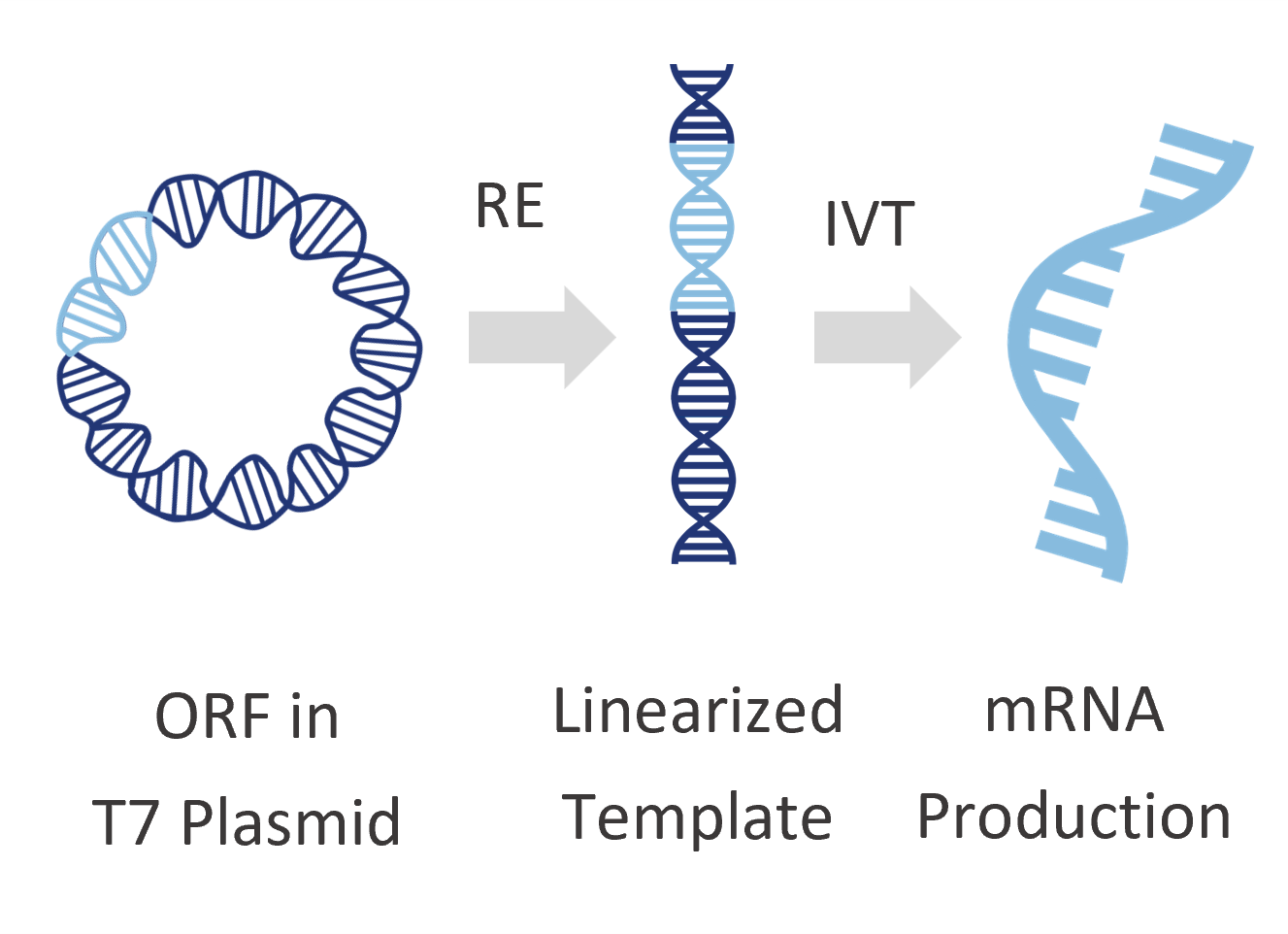
The baseScribe Mod Cap1 Kits enable the efficient production of Cap1‑capped, pseudouridine‑ or N1-methylpseudouridine‑modified mRNA by in vitro transcription (IVT) from DNA templates containing a T7 RNA polymerase promoter. The kits are designed for researchers who require translationally competent, immunosilent mRNA, generated in a single co‑transcriptional reaction.
Both kits are optimized for high yield and reproducibility and differ only in the uridine modification used:
- baseScribe Mod‑Pseudo Cap1 Kit: pseudouridine (Ψ)‑modified mRNA
- baseScribe Mod‑Methylpseudo Cap1 Kit: N1‑methylpseudouridine (m¹Ψ)‑modified mRNA
In both cases, all uridines in the transcript are replaced by the respective modified nucleotide.
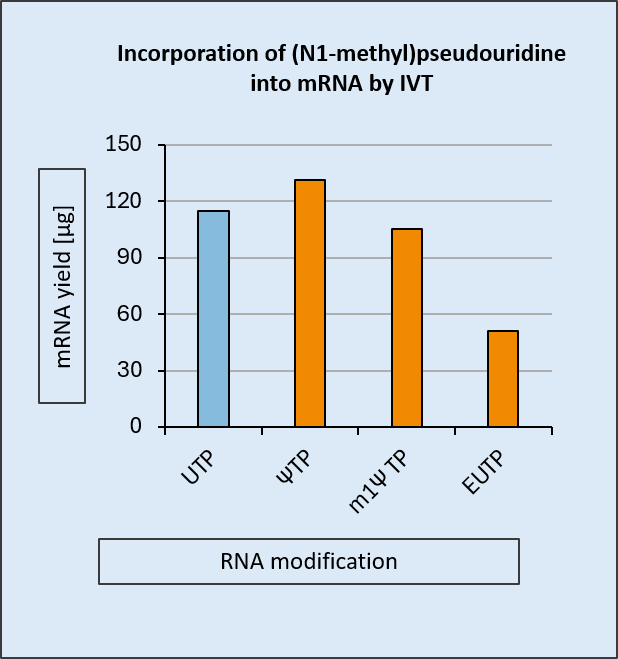
Fig.1: The baseScribe Mod Cap1 Kits enable the production of Cap1‑capped, pseudouridine‑ or N1-methylpseudouridine‑modified mRNAs in high yields and excellent quality.
High‑Yield mRNA Production from Minimal DNA Input
The kits are optimized for IVT from either 1 µg of linearized plasmid DNA or 200–500 ng of PCR‑derived DNA templates.
Each kit provides reagents for 20 standard reactions (20 µL each).
Depending on the template sequence, a single reaction typically yields 140–180 µg of modified, Cap1‑capped mRNA, corresponding to a total output of up to 3.6 mg mRNA per kit.
Co‑Transcriptional Cap1-Capping for Efficient Translation
Cap1-capping is performed co‑transcriptionally, generating RNA with a native‑like Cap1 structure during synthesis. This eliminates the need for post‑transcriptional capping steps and simplifies the workflow while producing RNA that is ready for downstream applications.
Optimized Enzyme System for Reliable RNA Synthesis
Both kits are based on the same optimized IVT Enzyme System and include:
- T7 RNA polymerase for efficient transcription
- Pyrophosphatase to prevent reaction inhibition by pyrophosphate
- A balanced transcription buffer supporting sustained enzyme activity
- RNase inhibitor and DNase I for template removal
This combination enables robust transcription efficiency and reproducible RNA quality across different templates and production batches. A linear DNA control template is included to allow evaluation of RNA yield and integrity.
Uridine-Modifications for Immunosilent mRNA
The two kit variants differ in the modified uridine triphosphate supplied:
- Pseudouridine triphosphate (ΨTP) for the generation of Ψ‑modified mRNA
- N1‑methylpseudouridine triphosphate (m¹ΨTP) for the generation of m¹Ψ‑modified mRNA
In both kits, the modified nucleotide fully replaces uridine, resulting in uniformly modified transcripts suitable for protein expression in vitro or in vivo.
RNA Quality and Downstream Compatibility
RNA generated with the baseScribe Mod Cap1 IVT Kits shows high integrity and homogeneity and can be purified using standard RNA cleanup methods.
The resulting mRNA is compatible with downstream applications including post‑transcriptional incorporation of clickable nucleotides at the 3′ end, enabling further functionalization via click chemistry.
Key Features
- One‑step synthesis of Cap1‑capped, modified mRNA
- Choice of pseudouridine (Ψ) or N1‑methylpseudouridine (m¹Ψ)
- 140–180 µg mRNA per reaction from 1 µg DNA
- 20 reactions per kit (20 µL each)
- Optimized T7‑based IVT system with pyrophosphatase
- Control template for performance verification included
Typical Applications
- Protein expression studies
- Functional mRNA research in vitro and in vivo
- Development and evaluation of modified mRNA constructs
- RNA engineering and chemical biology workflows
For research use only.
LITERATURE
Synthetic mRNAs with superior translation and stability properties, A. Grudzien‑Nogalska et al., Methods Mol Biol. 2013;969:55-72.
Incorporation of Pseudouridine Into mRNA Yields Superior Nonimmunogenic Vector With Increased Translational Capacity and Biological Stability, K. Karikó et al., 2008, Mol. Ther., Vol. 16, p. 1833–1840.
N1-methyl-pseudouridine in mRNA enhances translation through eIF2α-dependent and independent mechanisms by increasing ribosome density, I. Svitkin et al., Nucleic Acids Research, Volume 45, Issue 10, 2 June 2017, Pages 6023–6036.
Exploring RNA transcription and turnover in vivo by using click chemistry, C. Y. Jao et al., 2008, Proc. Natl. Acad. Sci. U.S.A. 105 (41) 15779-15784.
Self-coded 3′-Extension of Run-off Transcripts Produces Aberrant Products during in Vitro Transcription with T7 RNA Polymerase, Triana-Alonso, Francisco J. et al., Journal of Biological Chemistry, Volume 270, Issue 11, 6298 – 6307.
Studies of Promoter Recognition and Start Site Selection by T7 RNA Polymerase Using a Comprehensive Collection of Promoter Variants, D. Imburgio et al., Biochemistry 2000, 39, 34, 10419–1043.
FAQ
-
What are the baseScribe Mod Cap1 IVT Kits used for?
These kits enable the one‑step synthesis of Cap1‑capped mRNA fully substituted with pseudouridine (Ψ) or N1‑methylpseudouridine (m¹Ψ), producing translationally competent, immunosilent mRNA for in vitro and in vivo research.
-
What is the difference between the two kit variants?
- Mod‑Pseudo Cap1 Kit → generates Ψ‑modified mRNA
- Mod‑Methylpseudo Cap1 Kit → generates m¹Ψ‑modified mRNA
In both kits, all uridines are fully replaced by the modified nucleotide.
-
How much mRNA can one reaction produce?
A single 20 µL reaction typically yields 140–180 µg of modified, Cap1‑capped mRNA from:
- 1 µg linearized plasmid DNA, or
- 200–500 ng PCR‑derived DNA
Each kit supports 20 reactions, giving a total yield of up to 3.6 mg mRNA.
-
Does the kit require a separate capping reaction?
No. The kits use a co‑transcriptional Cap1‑capping mechanism, producing a native‑like Cap1 structure during transcription.
-
Which enzymes are included?
Each kit contains:
- T7 RNA polymerase (high‑efficiency)
- Pyrophosphatase to remove inhibitory pyrophosphate
- RNase inhibitor
- DNase I for template removal
- Optimized IVT transcription buffer
This system ensures robust, reproducible RNA synthesis.
-
Are the kits compatible with plasmid and PCR templates?
Yes. The kits support IVT using: Linearized plasmid DNA and PCR‑derived DNA fragments
-
Do pseudouridine and m¹Ψ improve RNA performance?
Yes. Both Ψ and m¹Ψ reduce innate immune activation and improve mRNA stability and translational efficiency. m¹Ψ often yields the highest translation efficiency in mammalian systems.
-
What RNA quality can be expected?
The IVT system produces mRNA with:
- High integrity and homogeneity
- Clean, well‑defined transcript bands
- Minimal truncated species
-
Can the resulting mRNA be further modified?
Yes, the IVT-generated mRNA is compatible with 3′ -end functionalization. Post-transcriptional 3′-incorporation of azido- or alkyne-modified ATPs by poly(A) polymerase enables the addition of dyes, affinity tags, or conjugation handles via click chemistry.
-
What are the intended applications?
- mRNA‑based protein expression
- Functional mRNA studies (in vitro / in vivo)
- Development of modified mRNA constructs
- RNA engineering and chemical biology workflows
-
Are these kits suitable for therapeutic manufacturing?
No. They are for research use only, not for clinical or GMP manufacturing.