


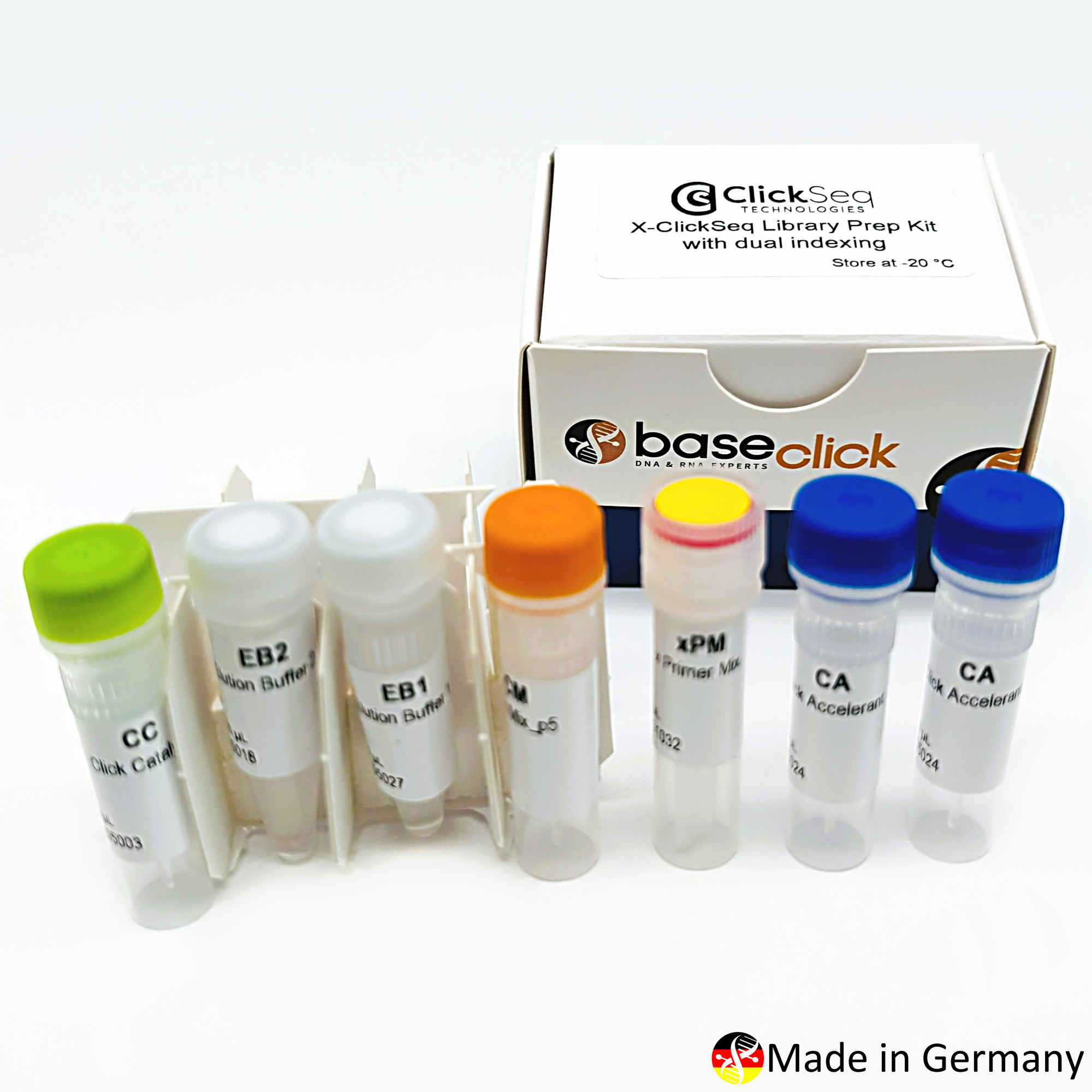
X-ClickSeq Library Prep Kit with dual indexing
Custom-Primer, Fragmentation-Free NGS Library Preparation for Illumina® Platforms

| Size | Catalog No. | Price |
|---|---|---|
| 12 rxn | BCK-X-RNAseqDual | € 396,00 |
Chemical Properties
-
Shelf Life
12 months unopened after receipt
-
Storage Conditions
– 20 °C
-
Physical State
kit system made of different components
-
CAS Number
n.a.
-
Preparation/Handling
please see user manual of the kit
Product Information
Technical Overview
X-ClickSeq Library Prep with Dual Indexing is a highly flexible kit for constructing next generation sequencing (NGS) libraries from RNA (or DNA), using click chemistry for adapter ligation. Unlike standard kits, X-ClickSeq™ empowers users to design and use their own reverse transcription (RT) primers, enabling targeted, tiled, or custom assays for applications such as viral genome sequencing, recombination analysis, and minority variant detection.
How It Works:
User Defined Priming: RNA is reverse transcribed using user-provided primers (e.g., random, tiled, or gene-specific), each containing a partial Illumina p7 adapter sequence. This enables targeted sequencing of specific regions or entire genomes.
- Azido-Termination: The presence of 3′-azido-nucleotides stochastically terminates cDNA synthesis, generating fragments terminated with 3′-azido groups.
- Click-Ligation: Azido-terminated cDNA fragments are covalently linked to alkyne-functionalized sequencing adapters via copper-catalyzed azide–alkyne cycloaddition (CuAAC), also known as click chemistry. This chemical ligation is highly efficient and enzyme-free.
- Dual Indexing PCR Amplification: Click-ligated fragments are PCR-amplified using unique pairs of i5 and i7 index primers, enabling robust sample multiplexing and error correction. The final libraries are fully compatible with Illumina sequencing workflows.

Workflow Summary
- Reverse Transcription: RNA is primed using user-provided primers with a partial p7 adapter, and copied in the presence of azido-nucleotides, generating 3′-azido-terminated cDNA fragments.
- Optional RNA Removal: RNase H can be used to remove template RNA.
- First Bead Purification: SPRI beads purify cDNA fragments.
- Click-Ligation: Alkyne-functionalized adapters are covalently attached to cDNA via click chemistry.
- Second Bead Purification: Removes reaction components, leaving adapter-flanked cDNA.
- PCR Amplification with Dual Indexing: Unique i5 and i7 index primers amplify and barcode each sample.
- Final Bead Purification & Size Selection: Yields sequencing-ready libraries (optimal size: 300–600 bp).
Library Topology
Final libraries include:
- Illumina p5 and p7 adapters
- Dual indices (i5 and i7)
- 4 nt UMI (unique molecular identifier)
- cDNA fragment
Kit Components
- x-Primer Mix (xPM) – no RT primer included user provides custom primer(s)
- Click Mix p5 (CM)
- Click Accelerant (CA)
- Click Catalyst (CC)
- Elution Buffers (EB1, EB2)
- Note: Enzymes (SuperScript III, RNase H, OneTaq Master Mix), user-provided RT primers, and SPRI beads are user-supplied. Dual Indexing Primers (i5 Index Primers (D501–D512), i7 Index Primers (D701–D712)) can be purchased here.
Key Features & Advantages
- Customizable Priming: Use any primer design—random, tiled, or gene-specific—for targeted sequencing or full-genome coverage.
- Fragmentation-Free: No need for mechanical or enzymatic fragmentation, preserving sample integrity and reducing workflow complexity.
- Ultra-Low Chimera Rate: Peer-reviewed studies report only ~3 chimeric events per million reads, supporting high-confidence variant and recombination detection.
- Ligation-Free: Click chemistry replaces enzymatic ligation, minimizing bias and unwanted byproducts.
- Dual Indexing: Supports both i5 and i7 indices for robust sample multiplexing and accurate sample tracking.
- Flexible Input Range: Works with 10 ng to 4 µg of RNA (optimal: >100 ng).
- Fast Protocol: Complete workflow in approximately 6 hours.
- Ready for Illumina Platforms: Generates libraries compatible with all major Illumina sequencers (NextSeq, NovaSeq, MiSeq, HiSeq).
- 12 Unique Dual-Index Primer Pairs: Enables multiplexing of up to 12 samples per kit.
Application Areas
Targeted Viral Genome Sequencing: Proven for complete SARS-CoV-2 genome sequencing with tiled primers.
Recombination & Minority Variant Detection: Simultaneous capture of recombination events and low-frequency variants (Jaworski et al., eLife 2021).
Flexible Targeted NGS: Design custom assays for any region, gene, or organism.
High-Throughput Screening: Dual indexing enables efficient multiplexing for large cohorts.
Technical Specifications
| Parameter | Specification |
| Input RNA | 10 ng – 4 µg (optimal: >100 ng) |
| Total time | ~6 hours including incubations |
| Library size | ~300–600 bp post‑cleanup |
| Indexing | Dual indexing (i5 + i7, 8‑nt) |
| UMI | 4 nt |
| PCR cycles | Typical 12–21 (optimize by input) |
| Platforms | Illumina® MiSeq, NextSeq, NovaSeq, HiSeq |
| Throughput | 12 libraries per kit |
| ROU | Not for diagnostic procedures |
Literature
- Jaworski et al., Tiled-ClickSeq for targeted sequencing of complete coronavirus genomes with simultaneous capture of RNA recombination and minority variants. eLife 2021;10:e68479. https://doi.org/10.7554/eLife.68479
- Routh, A., Head, S. R., Ordoukhanian, P., & Johnson, J. E. (2015). ClickSeq: Fragmentation-Free Next-Generation Sequencing via Click Ligation of Adaptors to Stochastically Terminated 3′-Azido cDNAs. Journal of Molecular Biology, 427(16), 2610-2616. https://doi.org/10.1016/j.jmb.2015.06.011
- Jaworski, E., & Routh, A. (2017). ClickSeq: Replacing Fragmentation and Enzymatic Ligation with Click-Chemistry to Prevent Sequence Chimeras. In Next Generation Sequencing: Methods and Protocols (pp. 71-85). Springer New York. https://doi.org/10.1007/978-1-4939-7514-3_6
FAQ
-
What is X-ClickSeq Library Prep with Dual Indexing?
X-ClickSeq is a next-generation sequencing (NGS) kit for Illumina platforms that enables users to design and use their own reverse transcription (RT) primers. This allows for targeted, tiled, or custom sequencing assays, such as viral genome sequencing, recombination analysis, and minority variant detection.
-
How is X-ClickSeq different from other ClickSeq kits?
Unlike DNA-, RNA-, or Poly(A)-ClickSeq, X-ClickSeq™ does not include RT primers. Users supply their own custom primers, enabling full flexibility for targeted sequencing (e.g., tiled amplicons for SARS-CoV-2, gene-specific assays).
-
What types of samples can be used?
X-ClickSeq is compatible with RNA or DNA samples. The kit is highly flexible and can be adapted for a wide range of organisms and targets, depending on the user’s primer design.
-
What are the main advantages of X-ClickSeq?
- Customizable priming: User-defined primers for targeted sequencing.
- Fragmentation-free: No need for mechanical or enzymatic fragmentation.
- Ultra-low chimera rate: Only ~3 chimeric events per million reads (Jaworski et al., eLife 2021; Routh et al., JMB 2015).
- Dual indexing: Robust sample multiplexing with i5 and i7 indices.
- Fast workflow: Complete protocol in ~6 hours.
-
What do I need to provide for the RT step?
You must supply your own RT primers, designed to include a partial Illumina p7 adapter sequence. Primer concentration should be 10–100 µM, and must be resuspended in nuclease-free water or Tris buffer (no EDTA).
-
What applications is X-ClickSeq best suited for?
- Targeted viral genome sequencing (e.g., SARS-CoV-2)
- Simultaneous detection of recombination and minority variants
- Custom targeted NGS for any gene, region, or organism
-
What is the recommended input amount?
The kit works with 10 ng to 4 µg of RNA or DNA (optimal: >100 ng).
-
Which sequencing platforms are compatible?
Libraries are fully compatible with all Illumina sequencing platforms (MiSeq, NextSeq, NovaSeq, HiSeq).
-
What is the typical library size?
The protocol yields libraries in the 300–600 bp range, optimal for Illumina sequencing.
-
Can I multiplex X-ClickSeq libraries with libraries from other kits?
It is not recommended, as differences in library topology and size may affect sequencing quality and data output.
-
What is the UMI and how is it used?
Each library molecule contains a 4 nt unique molecular identifier (UMI) for accurate deduplication and error correction during data analysis.
-
What quality control steps are recommended?
Quantify libraries using Qubit or BioAnalyzer, and check size distribution before pooling and sequencing.