

Fluorescence In Situ Hybridization (FISH) is a powerful molecular cytogenetic technique that enables the detection and localization of specific DNA or RNA sequences within cells or tissues. Fluorescent labeled probes that bind to complementary nucleic acid sequences enable the visualization of genetic material under a fluorescence microscope. This provides insights into chromosomal abnormalities, gene expression and cellular organization.
Why are FISH Kits & Probes Indispensable?
- FISH Kits provide standardized reagents, buffers, and protocols to streamline the hybridization process. Kits ensure consistent sample preparation, hybridization conditions, and signal detection, thereby reducing variability and improving the reliability of results across experiments.
- FISH Probes are fluorescent labeled DNA or RNA sequences designed to bind specifically to target genetic regions. They enable the precise localization of genes or chromosomal regions, which is crucial for identifying genetic mutations, translocations or amplifications associated with diseases such as cancer and genetic disorders.
So FISH Kits & Probes enable high-resolution genetic analysis, making them the perfect tools for clinical diagnostics, research, and personalized medicine.
What is FISH and how are FISH Kits used?
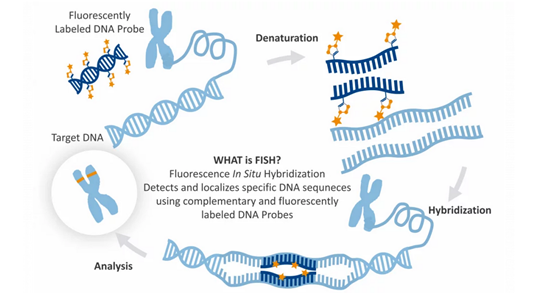
FISH is a set of laboratory methods that use fluorescent labeled probes — short sequences of DNA or RNA tagged with fluorescent dyes — that bind to complementary target sequences in the sample. These probes emit light when viewed under a fluorescence microscope, which reveals the precise location of the targeted genetic material.
How Does FISH Work?
- Sample Preparation: Cells or tissue sections are fixed onto a microscope slide.
- Denaturation: Heating or chemical treatment converts the DNA or RNA in the sample into a single strand, enabling probes to bind.
- Hybridization: Fluorescently labeled DNA or RNA probes are added. These probes are designed to be complementary to the sequence of interest.
- Washing: Excess probes are washed away, leaving only those bound to their targets.
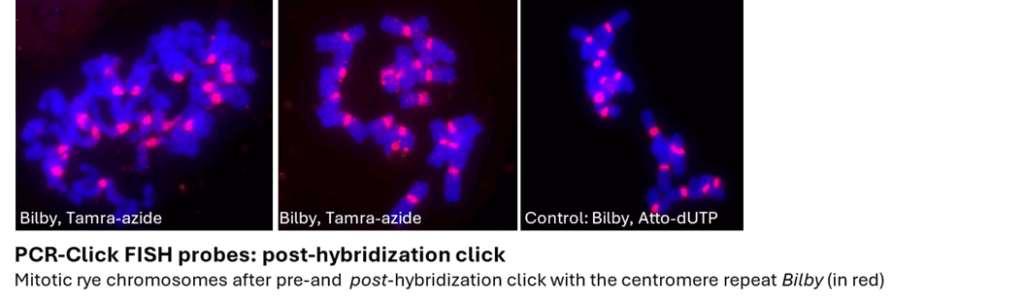
- Visualization: The slide is examined using a fluorescence microscope. The fluorescent signals indicate the location of the target sequences within the cells or tissue.
Components of a FISH Kit
A typical FISH kit contains the following components:
- Reagents for sample preparation: Solutions that fix and permeabilize cells or tissues, making the DNA/RNA accessible for probe binding.
- Hybridization Buffers that optimize the annealing of probes to target sequences under controlled conditions.
- Fluorescent Probes: DNA/RNA probes that are fluorescent labeled and specific to the target genetic sequences. These can be pre-designed or customizable.
- Wash Solutions are used to remove unbound probes and reduce background noise.
- Counterstain: Fluorescent dyes (e.g., DAPI) to stain nuclei for visualization.
- Mounting Medium: Solution to preserve the sample for microscopy.
This set of components for FISH kit ensures the accurate and reproducible visualization of DNA/RNA sequences in cells or tissues.
The role of FISH Probes
FISH probes are short single-stranded DNA or RNA sequences that are complementary to a specific target sequence in the sample. During hybridization, the probes bind to their target sequences through base-pairing (A-T, G-C for DNA; A-U, G-C for RNA), forming stable double-stranded hybrids.
This specific binding is enhanced by controlled conditions (temperature, salt concentration) in FISH kits, ensuring only complementary sequences pair, allowing precise localization of genetic material under a fluorescence microscope.
Types of FISH Probes:
- DNA Probes: Single-stranded DNA sequences targeting specific genomic regions, used to detect chromosomal abnormalities or gene locations.
- RNA Probes: Single-stranded RNA sequences designed to bind mRNA or non-coding RNA, ideal for studying gene expression or RNA localization.
DNA or RNA FISH probes are tagged with fluorescent dyes (e.g., FITC, Cy3 that emit light when excited. This enables the visualization of target sequences in cells or tissues without the need for separate detection reagents, unless signal amplification is required.
Probe design and labeling
FISH Probes Design:
- FISH probes are short, single-stranded DNA or RNA sequences (typically 20–100 nucleotides) that are complementary to a specific target sequence in the genome or transcriptome.
- To ensure specificity, probes are designed using bioinformatics tools to avoid cross-hybridization with non-target sequences. This includes checking for sequence uniqueness and melting temperature (Tm) optimization.
- Multiple FISH probes may be tiled across a region to amplify signal and improve detection sensitivity.
Applications of FISH Kits and Probes in research and diagnostics
FISH Kits and Probes are widely used in research and diagnostics to visualize specific DNA or RNA sequences in cells or tissues.
Research Applications:
- Gene mapping: The kits and probes help locate specific genes on chromosomes.
- Chromosomal rearrangement studies: The kits and probes are used to identify translocations, deletions, or duplications in cells, tissues or organisms.
- Cell cycle analysis: Tracking chromosomal behavior during mitosis or meiosis.
Diagnostic Applications:
- Cancer diagnostics: FISH kits and probes can detect genetic alterations in tumors, such as HER2 amplification in breast cancer and ALK rearrangements in lung cancer, thereby guiding targeted therapies.
- Prenatal testing: Identification of the chromosomal abnormalities in fetal cells from amniotic fluid or chorionic villi, diagnosing conditions such as Down syndrome (trisomy 21).
- Hematological disorders: The kits and probes are used to diagnose and monitor leukemias and lymphomas by detecting specific translocations (e.g., Philadelphia chromosome in chronic myeloid leukemia).
- Microbial identification: The kits and probes provide a rapid detection of pathogens in clinical samples (e.g., E. coli, Mycobacterium tuberculosis).
Advantages of using ready-to-use FISH Kits
Ready-to-use FISH kits offer significant advantages for research and diagnostics:
- Saves Time: The kits provide faster sample processing.
- High Reproducibility: standardized protocols ensure consistent results and reduce a variability across labs.
- Supports Research & Diagnostics: validated protocols ensure consistent performance in both scientific and clinical applications.
Challenges and limitations of FISH Kits and FISH Probes
- Signal-to-Noise Ratio: Low signal intensity or high-background noise can affect interpretation of the results.
- Probe Specificity: Non-specific, off-target hybridization may lead to false positives, reducing accuracy.
- Sample Quality: Poorly prepared or degraded samples compromise results.
- Experienced Handling Required: FISH protocols are complicated and require skilled personnel to ensure they are performed and interpreted properly.
Future perspectives and innovations in FISH Kit Technology
Future Perspectives
- Multiplex FISH: Enables simultaneous detection of multiple genetic targets (up to 12+ via RNAscope Hi-plex). This improves the comprehensive genomic profiling necessary for personalized cancer therapies and complex disease research.
- Digital Imaging: AI-driven analysis (e.g., MERFISH, HCR platforms) improves signal quantification and reduces operator bias of FISH signals, improving diagnostics in clinical applications.
- Automated Evaluation: Fully integrated systems (e.g., confocal WSI scanners, ISM-FISH) streamline workflows, boost reproducibility, and support high-throughput screening for both research and diagnostic. AI-assisted image analysis will reduce human error and speed up diagnostics.
baseclick offers the ClickTech DNA FISH Kit, a fast and reliable solution for generating highly fluorescent DNA probes using click chemistry. The kit ensures strong signal intensity, easy handling, and customizable dye options for precise FISH analysis.
Another innovative solution from baseclick, the ClickTech PCR Modification Kit enables direct labeling of PCR products through a streamlined click chemistry workflow. With optimized reagents and ethynyl-modified nucleotides, it supports efficient probe generation for molecular and genetic applications.