


ARCA (Anti-Reverse Cap Analog)
Cap Analog
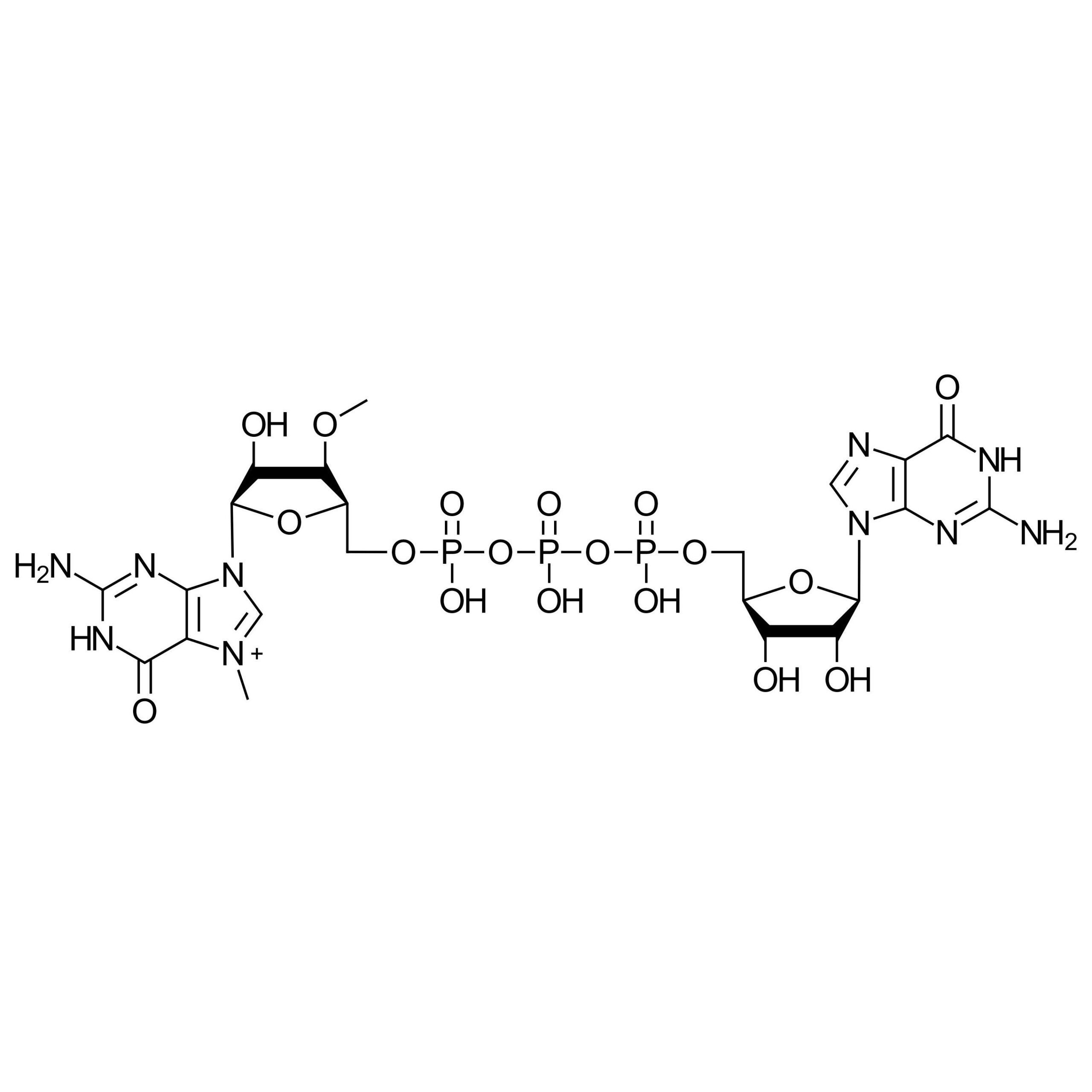
| Size | Catalog No. | Price |
|---|---|---|
| 1 µmol | BCT-24-S | € 90,00 |
| 5 µmol | BCT-24-L | € 380,00 |
Chemical Properties
-
Molecular Formula
C22H31N10O18P3
-
Shelf Life
12 months unopened after receipt
-
Storage Conditions
-20 °C, RNase free
-
Molecular Weight
816.46 g/mol
-
Purity
≥ 98% (HPLC)
-
Physical State
100 mM clear colorless aquaeous solution
-
CAS Number
400806-46-4 (acid)
400806-60-2 (sodium salt) -
Absorption (max)
λmax = 255 nm
-
Ɛ (max)
22,600 cm-1M-1
-
Additional name
m27,3′-OGP3G; m27,3′-OG(5′)ppp(5′)G; P1-(5′-(3′-O-methyl)-7-methyl-guanosyl) P3-(5′-(guanosyl))triphosphate, Sodium salt
Product Information
High‑Performance Cap Analog for Co‑Transcriptional mRNA Capping
ARCA (Anti‑Reverse Cap Analog) is a high‑purity cap analog used during in vitro transcription (IVT) to generate translationally active capped mRNA.[1] Traditional cap analogs can be incorporated in both forward and reverse orientations, leading to a fraction of non‑functional transcripts. ARCA solves this issue by chemically blocking the 3′‑OH group of the 7‑methylguanosine residue, ensuring that it only incorporates in the forward orientation.
This orientation specificity results in mRNA with significantly improved translation efficiency, higher protein expression, and greater mRNA stability. ARCA is widely used in mRNA research, synthetic biology, gene expression studies, and IVT‑based assay development.
Product Features
- Guaranteed Forward Orientation
The 3′‑O‑methyl modification prevents reverse incorporation, producing 100% translatable capped transcripts.
- Improved mRNA Stability & Translation
ARCA‑capped mRNA shows longer half‑life and enhanced translational output compared to conventional m7G caps.
- High-Purity Reagent
Purity ≥98% (HPLC), supplied as a 100 mM clear aqueous solution.
- Co‑Transcriptional Integration
Compatible with standard T7‑based IVT workflows; typically used at a 4:1 ARCA:GTP ratio for ~80 % capping efficiency.
- Cap0 Structure
ARCA produces a Cap0 structure (m⁷GmpppG), suitable for various research applications that do not require Cap1 specificity.
Application Areas of ARCA
- Co‑Transcriptional mRNA Capping
ARCA is incorporated directly during in vitro transcription to generate capped transcripts in a forward‑only orientation, avoiding non‑functional reverse caps. This ensures that all resulting mRNAs are fully translatable and higher‑performing compared to those made with conventional symmetric cap analogs.
- Enhanced mRNA Translation Efficiency
ARCA‑capped mRNAs show increased translation efficiency because the cap is always incorporated in the correct orientation. This leads to stronger protein expression and more reliable experimental results.
- Improved mRNA Stability
The correctly oriented Cap0 structure protects the 5′‑end of the RNA from exonuclease degradation. As a result, ARCA‑capped transcripts typically exhibit a longer half‑life in both cell‑free and cellular systems.
- mRNA Production for Transfection Studies
ARCA produces fully functional capped mRNA suitable for high‑efficiency cell transfection. This is essential for reporter assays, gene expression studies, and transient protein production.
- Cell‑Free Translation & Lysate Systems
Because ARCA ensures 100% forward capping, the resulting mRNA performs reliably in cell‑free systems such as reticulocyte lysate or wheat germ extract. This consistency is crucial for in vitro translation assays requiring high protein yields.
- Microinjection & Embryo/Oocyte Studies
ARCA‑capped mRNA maintains stability and translation efficiency when introduced into oocytes or embryos via microinjection. This makes ARCA suitable for applications where uncapped or poorly capped mRNAs are rapidly degraded or poorly expressed.
- Screening & High‑Throughput mRNA Experiments
The reliable forward‑only orientation of ARCA reduces transcript variability, making it ideal for screening assays that depend on consistent mRNA expression. This stability is valuable in pathway studies, drug screens, and functional genomics.
- Gene‑Editing mRNA Workflows (CRISPR, TALENs, Recombinases)
ARCA‑capped mRNAs provide the strong translation needed for efficient gene‑editing activity. This makes ARCA a preferred reagent for producing functional mRNAs used in genome engineering experiments.
How ARCA Works
During IVT, standard m7GpppG cap can insert in either direction. ARCA’s 3′‑OMe design blocks insertion in the reverse orientation, so that the polymerase can only start transcription with a functional mRNA 5´end.[1] The resulting capped mRNA is:
- fully compatible with eIF4E‑mediated translation
- more stable against exonuclease degradation
- free from reverse‑capped, non‑functional species
Comparison Table of baseclick´s Capping structures
| Feature / Reagent | Cap0 (ARCA) | Cap1 (CleanCap®) | Azido‑hexynyl‑pApG | Amino‑hexynyl‑pApG | Alkyne‑C8‑pApG |
| Cap Structure | m⁷GmpppG (Cap0) | m⁷GpppAmG (Cap1: natural eukaryotic cap) | Modified cap initiator with azido group | Modified cap initiator with primary amine | Modified cap analog with alkyne group |
| How it Works | Co‑transcriptional capping; 3′‑O‑methyl prevents reverse orientation | Co‑transcriptional trinucleotide capping with natural AG start; produces Cap 1 | Provides an azide handle on the 5′‑end for click chemistry | Enables NHS‑ester conjugation at 5′‑end | Provides an alkyne handle on the 5′‑end for click chemistry |
| Main Purpose | Produces fully translatable Cap0 mRNA with improved stability & translation | Produces Cap1 mRNA with high biological compatibility and reduced innate immune activation | 5′‑end click‑chemistry-based functionalization | 5′‑end NHS‑ester conjugation | 5′‑end click‑chemistry-based functionalization |
| Immune Profile | Higher innate immune activation than Cap1 | Lowest immune activation; matches that of natural mRNA | For transcript modification; immune profile depends on attached ligand | For transcript modification; immune profile depends on attached ligand | For transcript modification; immune profile depends on attached ligand |
| Typical Usage | Research‑grade mRNA, cell‑free translation, transfection, reporter assays | Therapeutic‑grade mRNA, vaccines, gene therapy | Bio‑orthogonal labeling of mRNA at 5′‑end | Dye/ligand attachment via NHS chemistry | Copper‑catalyzed click labeling at 5′‑end |
Literature
[1] Synthesis and properties of mRNAs containing the novel “anti-reverse” cap analogs 7-methyl(3′-O-methyl)GpppG and 7-methyl(3′-deoxy)GpppG. J.Stepinski et al., 2001, RNA, Vol. 7(10), p. 1486-1495.
Novel “anti-reverse” cap analogs with superior translational properties, J. Jemielity et al., 2003, RNA, Vol. 9, p. 1108-1122.
https://doi.org/10.1261/rna.5430403
Synthesis and Application of a Chain-Terminating Dinucleotide mRNA Cap Analog, Z. Peng et al., 2002, Org. Lett., Vol. 4(2), p. 161-164.
https://doi.org/10.1021/ol0167715
5-Ethynyluridine: A Bio-orthogonal Uridine Variant for mRNA-Based Therapies and Vaccines, S. Maassen et al., 2023, ChemBioChem, Vol. 24(5), e202200658.
https://doi.org/10.1002/cbic.202200658
Chemoenzymatic Preparation of Functional Click-Labeled Messenger RNA, S. Croce et al., 2020, ChemBioChem, Vol. 21(11), p. 1641-1646.
FAQ
-
What cap structure does ARCA produce?
ARCA yields a Cap0 structure, the basic 7‑methylguanosine cap found at the 5′ end of many eucaryotic mRNA transcripts.[1]
-
How does ARCA improve translation?
Because ARCA cannot be incorporated in the reverse orientation, 100% of the capped transcripts are translatable, resulting in higher protein output.[1]
-
What is the typical capping efficiency with ARCA?
Approximately 80%, when using a 4:1 ARCA:GTP ratio during IVT.
-
How does ARCA compare to CleanCap®?
- ARCA → Cap0, requires GTP competition, lower yields.
- CleanCap® → Cap1, no GTP competition needed, higher yields and better innate immune profile than ARCA.