


PCR Modification Kit
Preparation of fluorescent-labeled DNA products by PCR
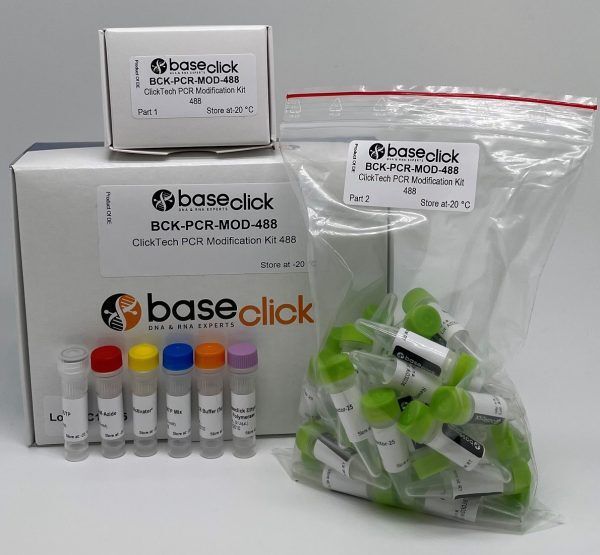
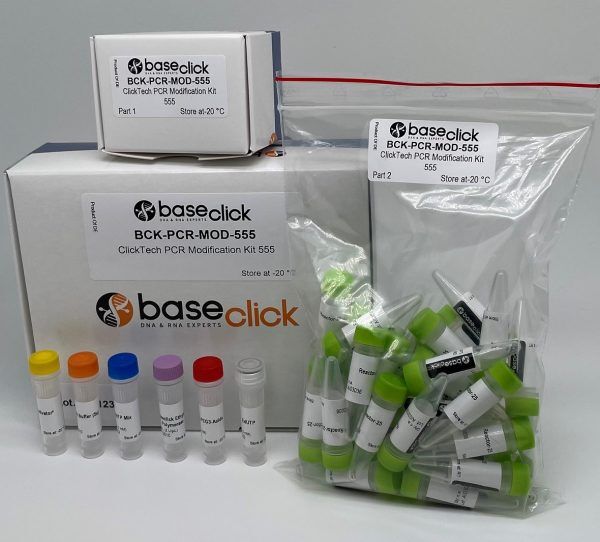
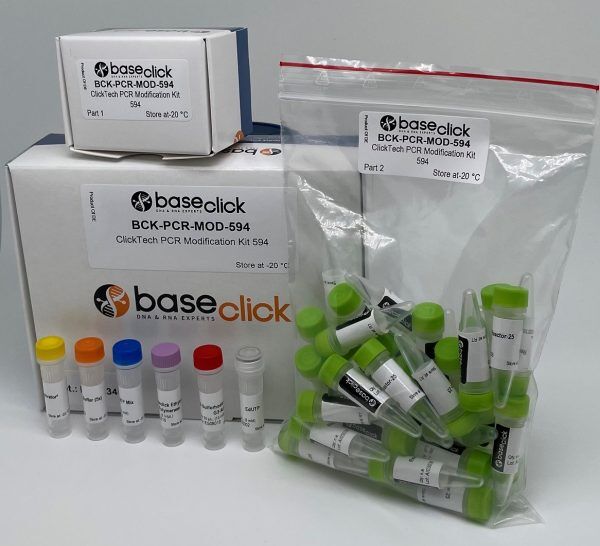
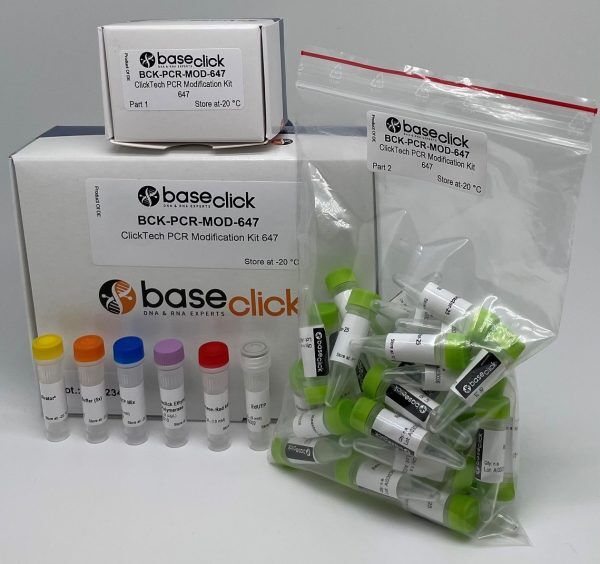
| Size | Catalog No. | Price |
|---|---|---|
| Dye 488 | BCK-PCR-MOD-488 | € 500,00 |
| Dye 555 | BCK-PCR-MOD-555 | € 500,00 |
| Dye 594 | BCK-PCR-MOD-594 | € 500,00 |
| Dye 647 | BCK-PCR-MOD-647 | € 500,00 |
Chemical Properties
-
Shelf Life
12 months unopened after receipt
-
Storage Conditions
– 20 °C
-
Physical State
kit system made of different components
-
CAS Number
n.a.
-
Excitation (max)
Dye 488: 496 nm | Dye 555: 546 nm | Dye 594: 584 nm | Dye 647: 643 nm
-
Emission (max)
Dye 488: 516 nm | Dye 555: 579 nm | Dye 594: 603 nm | Dye 647: 662 nm
-
Ɛ (max)
Dye 488: 83.000 cm-1M-1 | Dye 555: 91.000 cm-1M-1 | Dye 594: 110.000 cm-1M-1 | Dye 647: 250.000 cm-1M-1
-
Preparation/Handling
please see user manual of the kit
Product Information
High‑Density Fluorescent Labeling of PCR Products using Click Chemistry
The ClickTech PCR Modification Kit is a versatile, next‑generation solution for generating highly fluorescent, alkyne‑modified DNA products directly during PCR. Built on the same proven click chemistry platform as baseclick’s FISH labeling technology, this kit offers a powerful way to prepare intensely labeled DNA fragments for a broad range of downstream applications — from probe generation and hybridization workflows to general molecular detection tasks.
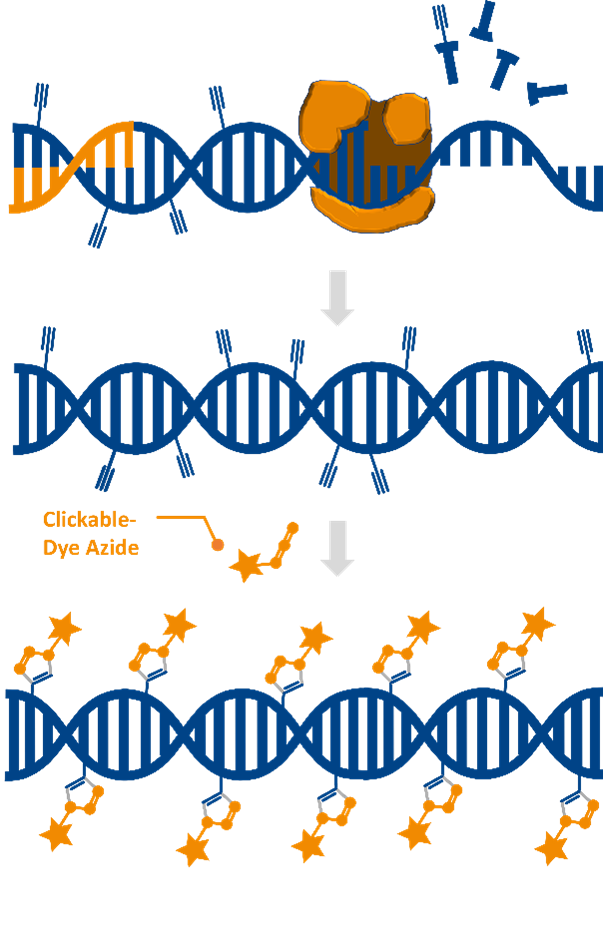
By incorporating EdUTP, an alkyne‑modified nucleotide, during amplification with baseclick´s optimized Ethynyl Polymerase, the resulting PCR products contain precisely placed alkyne handles. These can then be coupled to a clickable fluorescent dye of your choice via a highly selective copper‑catalyzed azide‑alkyne cycloaddition (CuAAC) reaction.
The result: bright, stable, cleanly labeled DNA products compatible with a wide range of hybridization and visualization techniques.
Key Features
- Efficient Two‑Step Labeling Workflow
PCR incorporation of EdUTP using Ethynyl Polymerase: The Ethynyl Polymerase amplifies the target sequence while incorporating EdUTP, an alkyne‑modified nucleotide into the DNA strand. These alkyne groups function as reactive click handles for later fluorescent labeling.
Click labeling with included azide‑functional fluorescent dye: Azide‑functionalized dyes (488, 555, 594, 647) react efficiently with the alkyne groups via CuAAC click chemistry. This yields densely labeled DNA FISH probes decorated with numerous covalently attached fluorophores, providing strong, clean, and highly stable fluorescence signals for hybridization assays.
- Complete Kit – Everything Included
-
- dNTP Mix (10 mM)
- EdUTP (5 mM)
- baseclick Ethynyl Polymerase (2 U/µL)
- PCR Buffer (5×)
- 10× Activator2
- Click reagent + dye (488, 555, 594, or 647)
- Supports 20 PCR Reactions and 40 Labeling Reactions per Kit with
Four Dye Choices for Multiplexing
-
- 488 (green) – Ex 496 / Em 516 nm
- 555 (yellow) – Ex 546 / Em 579 nm
- 594 (orange) – Ex 584 / Em 603 nm
- 647 (red) – Ex 643 / Em 662 nm
- High Labeling Density & Low Background
Click chemistry ensures selective, efficient labeling with minimal nonspecific fluorescence.
Applications
The ClickTech PCR Modification Kit is positioned for broader DNA labeling needs, including:
- Generation of fluorescent probes for hybridization assays: ideal for FISH‑like workflows or any DNA‑targeting application requiring strong signal contrast.
- Labeling of PCR products for visualization or tracking: useful in molecular genetics, DNA mapping, or tracer experiments.
- Multi‑color detection studies: using four dye options for simultaneous analysis of multiple targets.
- Detection and quantification in microarray or blotting systems.
- Preparation of custom fluorescent DNA probes: for labs that prefer producing their own probes rather than purchasing pre‑labeled oligos.
How It Works
- PCR Amplification with EdUTP
During amplification, the Ethynyl Polymerase incorporates EdUTP alongside natural dNTPs, creating alkyne-modified DNA.
- Click‑Labeling Reaction
The alkyne groups on the DNA react selectively with the kit’s azide‑linked fluorescent dye under mild copper‑catalyzed conditions, producing a stable covalent bond.
This method ensures highly efficient conversion of PCR product into bright fluorescent DNA.
Literature
Orthogonal End Labelling of Oligonucleotides through Dual Incorporation of Click-Reactive NTP Analogues. E. Schönegger et al., 2024, ChemBioChem., Vol. 25(1), e202300701.
https://doi.org/10.1002/cbic.202300701
Divergent Synthesis of Ultrabright and Dendritic Xanthenes for Enhanced Click-Chemistry-Based Bioimaging. L. Montiel et al., 2023, Eur. J., Vol. 29(5), e202202633.
https://doi.org/10.1002/chem.202202633
Click Chemistry Enables Rapid Amplification of Full-Length Reverse Transcripts for Long-Read Third Generation Sequencing. E. Schönegger et al., 2022, Bioconjugate Chem., 33(10), p. 1789–1795.
https://doi.org/10.1021/acs.bioconjchem.2c00353
ClampFISH detects individual nucleic acid molecules using click chemistry–based amplification. S. H. Rouhanifard et al., 2019, Biotechnol., Vol 37, p. 84–89.
FAQ
-
What is the ClickTech PCR Modification Kit used for?
The kit is designed for the generation of fluorescently labeled DNA products directly during PCR using click chemistry. It introduces alkyne groups into DNA via EdUTP, which are later fluorescently labeled using an azide‑dye reaction.
-
How many reactions can I perform with one kit?
Each kit supports 20 PCR reactions (50 µL each) and 40 independent click‑labeling reactions.
-
What polymerase is included?
The kit contains baseclick’s optimized Ethynyl Polymerase, which efficiently incorporates EdUTP along with natural dNTPs during PCR.
-
What is EdUTP and why is it important?
EdUTP is an alkyne‑modified nucleotide that introduces clickable alkyne groups into newly synthesized DNA, enabling selective dye coupling via click chemistry.
-
What storage conditions does the kit require?
Storage: −20 °C
Shelf life: 12 months (unopened)
-
What downstream applications are supported?
The fluorescently labeled PCR products can be used for:
- DNA detection assays
- Probe generation
- Hybridization workflows
-
Can the labeled PCR products be used for FISH?
Yes, although marketed for PCR labeling, the chemistry is identical to the DNA FISH Kit. The labeled products can be used in hybridization‑based detection, including FISH‑type assays.