


DNA FISH Kit
Preparation of fluorescent-labeled DNA probes by PCR
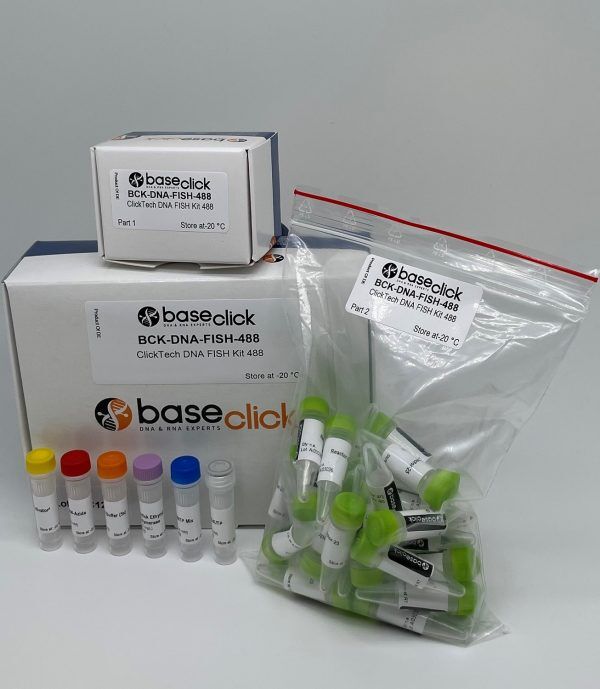

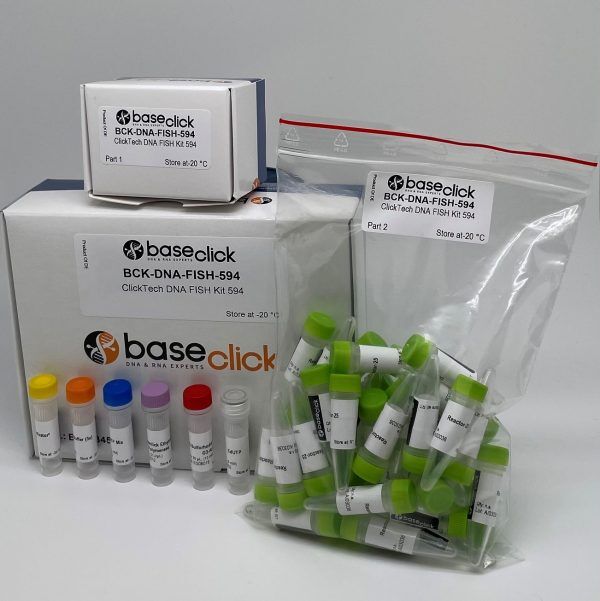
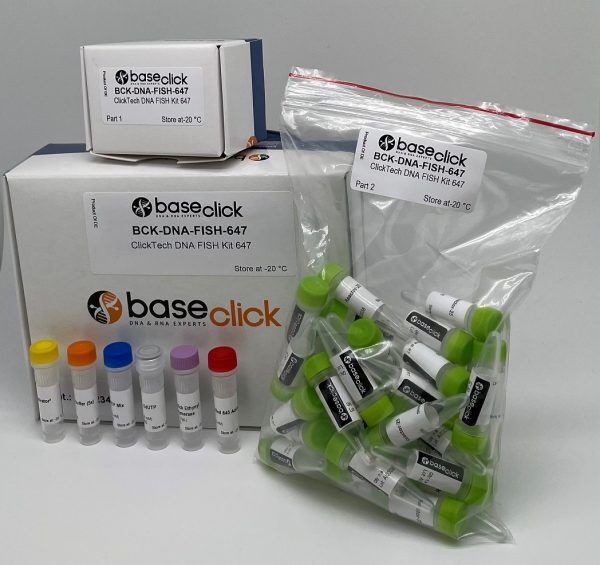
| Size | Catalog No. | Price |
|---|---|---|
| Dye 488 | BCK-DNA-FISH-488 | € 500,00 |
| Dye 555 | BCK-DNA-FISH-555 | € 500,00 |
| Dye 594 | BCK-DNA-FISH-594 | € 500,00 |
| Dye 647 | BCK-DNA-FISH-647 | € 500,00 |
Chemical Properties
-
Shelf Life
12 months unopened after receipt
-
Storage Conditions
– 20 °C
-
Physical State
kit system made of different components
-
CAS Number
n.a.
-
Excitation (max)
Dye 488: 496 nm | Dye 555: 546 nm | Dye 594: 584 nm | Dye 647: 643 nm
-
Emission (max)
Dye 488: 516 nm | Dye 555: 579 nm | Dye 594: 603 nm | Dye 647: 662 nm
-
Ɛ (max)
Dye 488: 83.000 cm-1M-1 | Dye 555: 91.000 cm-1M-1 | Dye 594: 110.000 cm-1M-1 | Dye 647: 250.000 cm-1M-1
-
Preparation/Handling
please see user manual of the kit
Product Information
High‑Efficiency Fluorescent DNA Probe Generation
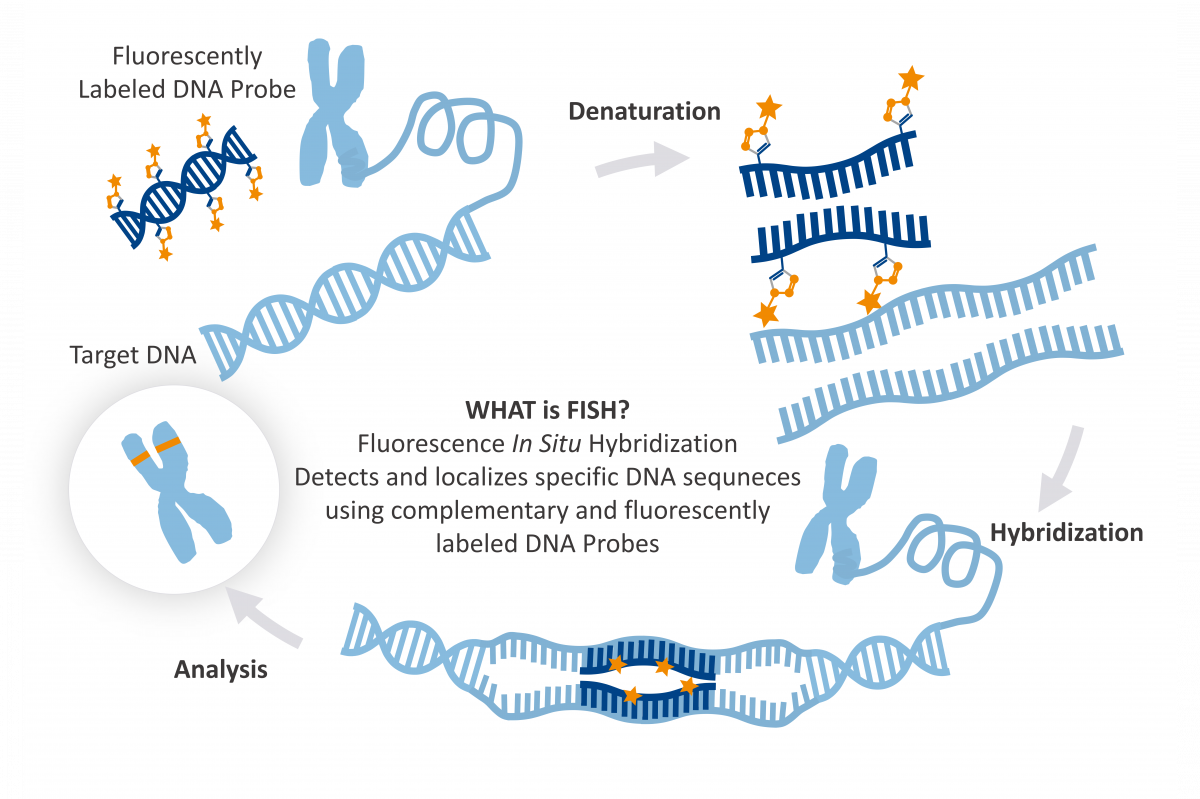
The ClickTech DNA FISH Kit enables fast, reliable, and highly efficient preparation of fluorescently labeled DNA probes for Fluorescence in situ Hybridization (FISH) applications. FISH is an essential cytogenetic method for detecting and localizing specific DNA or RNA sequences in cells or tissues, widely used in basic research as well as in clinical contexts such as cancer diagnostics, genetic syndrome analysis, and prenatal screening.
Traditional FISH methods often struggle with weak fluorescence due to low incorporation of dye‑labeled nucleotides. In contrast, baseclick’s technology incorporates alkyne‑modified EdUTP directly during PCR, allowing dense downstream dye conjugation through click chemistry. This results in remarkably bright, saturated probes, producing strong, clean signals even in challenging chromatin environments.
How the ClickTech DNA FISH Kit Works
During PCR amplification, the provided Ethynyl Polymerase incorporates a mixture of natural dNTPs and alkyne‑modified EdUTP, generating a “clickable” DNA amplicon. In a subsequent step, the included click reagents covalently attach the fluorescent azide dye of your choice (488, 555, 594, or 647) resulting in intense, stable, and uniformly labeled DNA FISH probes.
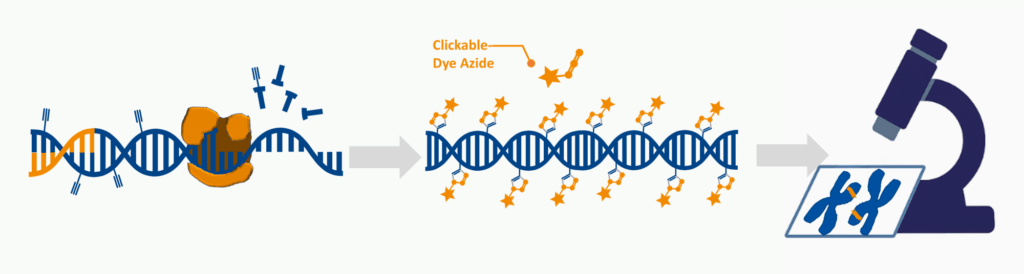
- High labeling density: Produces bright, sensitive probes with significantly improved signal‑to‑noise ratio.
- Universal dye options: Four clickable dyes included—green (488), yellow (555), orange (594), red (647)—allowing flexible multicolor FISH assay design.
- The complete workflow in one kit: Contains all reagents for PCR, click labeling, and probe generation.
- Efficient performance: Supports 20 PCR reactions (50 µL each) and 40 labeling reactions for independent FISH experiments.
- High-quality fluorescence characteristics:
- 488: Ex 496 nm / Em 516 nm
- 555: Ex 546 nm / Em 579 nm
- 594: Ex 584 nm / Em 603 nm
- 647: Ex 643 nm / Em 662 nm
- Storage-friendly: Long shelf life of 12 months when stored at –20 °C.
Applications
- Cancer Cytogenetics & Oncology Research
FISH is widely used in diagnosing and characterizing cancer, including:
-
- Detection of translocations (e.g., BCR‑ABL)
- Copy number variations (CNVs)
- Gene amplification (e.g., HER2)
The high sensitivity of ClickTech probes enhances the detection of subtle aberrations in heterogeneous tumor samples.
- Genetic Syndrome Diagnostics
FISH remains indispensable for identifying chromosomal abnormalities that cause genetic syndromes. Applications include detection of:
-
- Microdeletions
- Trisomies
- Structural rearrangements
The ClickTech kit’s high labeling density ensures reliable detection even in prenatal cytogenetic samples.
- Prenatal & Postnatal Screening
ClickTech DNA FISH probes are ideal for rapid screening assays in:
-
- Amniocytes
- Chorionic villi
- Neonatal blood smear nuclei
The strong signal allows accurate detection even on low‑quality or partially condensed samples.
- Single‑Cell Genomics & Nuclear Architecture Mapping
Researchers studying 3D genome organization or nuclear compartmentalization can benefit from the kit’s:
-
- High probe intensity
- Reliable locus targeting
This enables elegant visualization of chromosomal territories and long‑range interactions in single nuclei.
- Detection of Viral Integration or Transgenic Insertions
Bright DNA FISH probes allow precise identification of exogenous sequences in:
-
- Viral integration studies
- CRISPR/Cas9 genome engineering validation
- Stable transfection screening workflows
- Chromosomal Spread Analyses in Basic Research
For routine cytogenetic studies involving metaphase spreads, the ClickTech DNA FISH Kit delivers superior clarity, ideal for:
-
- Karyotyping research
- Evolutionary biology
- Comparative genomics
- Diagnostic and Research Lab Multiplex Panels
Because the dyes span the green‑to‑far‑red range, the kit supports robust multiplex FISH applications such as:
-
- 4‑locus panels
- Fusion gene co‑localization
- Multi‑color chromosome painting
Literature
Orthogonal End Labelling of Oligonucleotides through Dual Incorporation of Click-Reactive NTP Analogues. E. Schönegger et al., 2024, ChemBioChem., Vol. 25(1), e202300701.
https://doi.org/10.1002/cbic.202300701
Divergent Synthesis of Ultrabright and Dendritic Xanthenes for Enhanced Click-Chemistry-Based Bioimaging. L. Montiel et al., 2023, Eur. J., Vol. 29(5), e202202633.
https://doi.org/10.1002/chem.202202633
Click Chemistry Enables Rapid Amplification of Full-Length Reverse Transcripts for Long-Read Third Generation Sequencing. E. Schönegger et al., 2022, Bioconjugate Chem., 33(10), p. 1789–1795.
https://doi.org/10.1021/acs.bioconjchem.2c00353
ClampFISH detects individual nucleic acid molecules using click chemistry–based amplification. S. H. Rouhanifard et al., 2019, Biotechnol., Vol 37, p. 84–89.
FAQ
-
What dyes are available for this kit?
The kit supports four clickable dyes: 488, 555, 594, and 647, each with defined excitation/emission maxima.
-
How many reactions can I perform with one kit?
Each kit provides reagents for 20 PCR reactions and 40 separate labeling reactions.
-
What is the storage condition?
Store all kit components at –20 °C; the kit has a 12‑month shelf life when unopened.
-
What samples can I use?
The DNA FISH probes generated can be hybridized to chromosome spreads or nuclei of whole cells immobilized on glass slides.
-
Is the kit RUO (Research Use Only)?
Yes, the ClickTech DNA FISH Kit is designated Research Use Only (RUO).
-
Does the kit improve labeling efficiency compared to traditional FISH methods?
Yes. Traditional FISH often results in low labeling density and high background noise. The click‑chemistry–based approach provides dense fluorescent labeling for higher sensitivity.