


5/6-Sulforhodamine 101-PEG3-Azide
Texas Red Alternative fluorescent dye to label DNA/RNA
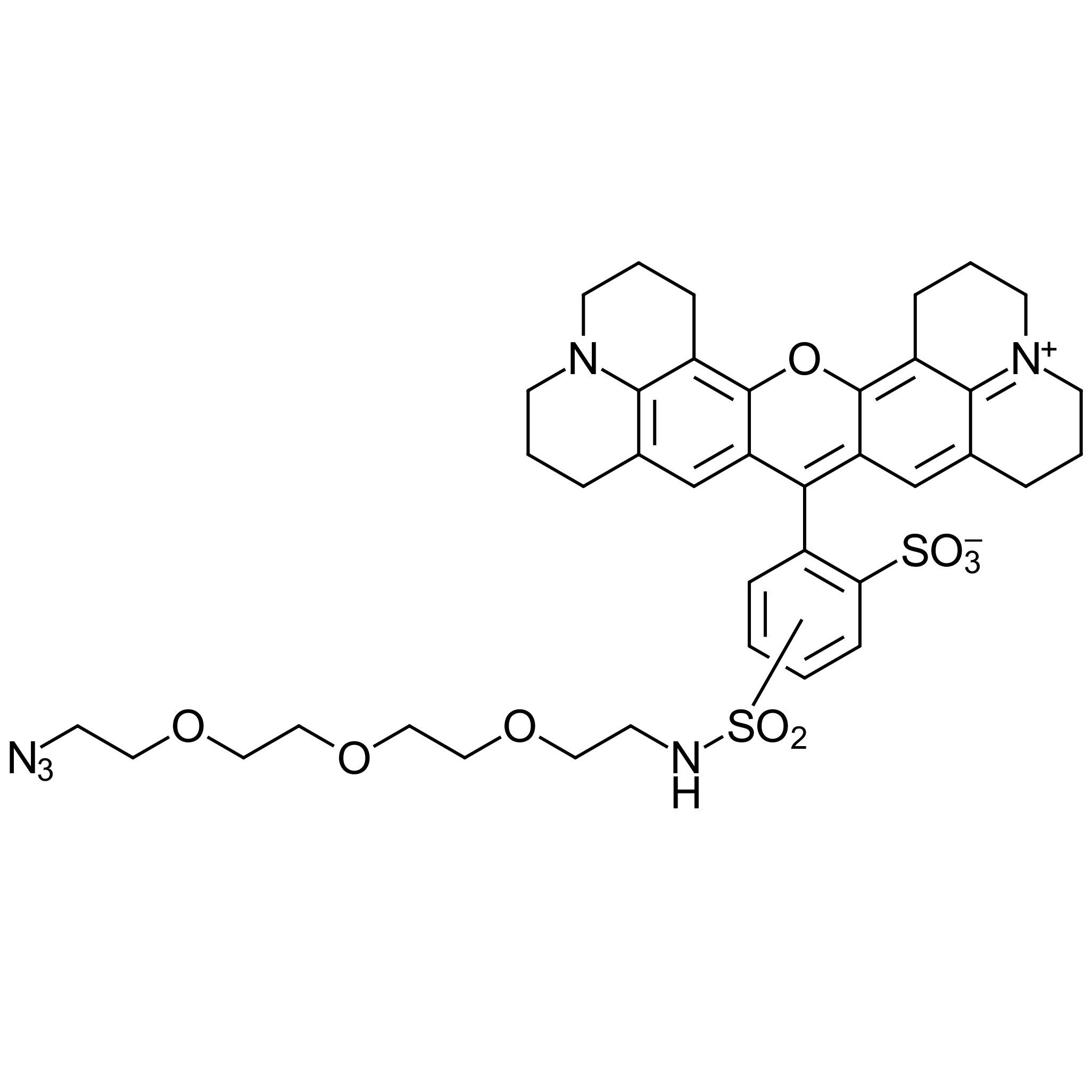
| Size | Catalog No. | Price |
|---|---|---|
| 5 mg | BCFA-044-5 | € 240,00 |
Chemical Properties
-
Molecular Formula
C39H46N6O9S2
-
Shelf Life
12 months unopened after receipt
-
Storage Conditions
-20 °C, dark
-
Molecular Weight
806.95 g/mol
-
Purity
≥ 90% (HPLC)
-
Physical State
dark red to dark blue solid
-
CAS Number
n.a.
-
Additional name
Texas Red; Red-emitting fluorophore
-
Excitation (max)
584 nm
-
Emission (max)
603 nm
-
Ɛ (max)
110,000 cm-1 M-1
-
Solubility
DMSO, DMF, MeOH
-
Preparation/Handling
For a 10 mM solution add 123 μL to 1 mg.
Product Information
The red fluorophore for precision click chemistry labeling and high‑contrast imaging
5/6-Sulforhodamine 101-PEG3-Azide is a bright, red‑emitting, azide‑functionalized dye optimized for CuAAC and SPAAC click‑chemistry reactions. With excitation and emission maxima at λex ≈ 584 nm and λem ≈ 603 nm, it provides intense, photostable fluorescence compatible with Alexa Fluor® 594 or DyLight 594, and is compatible with common laser lines (568 nm and 594 nm).
The dye incorporates a PEG3 linker, enhancing aqueous solubility and reducing steric hindrance during labeling. Its structural optimization improves stability compared to older sulforhodamine variants while maintaining identical optical properties.
5/6‑Sulforhodamine 101‑PEG3‑Azide is widely used across click‑enabled biomolecule labeling workflows—including DNA labeling, protein conjugation, nanotechnology, and advanced cell imaging—and serves as the red fluorescent dye in the ClickTech EdU cell proliferation kits.
Key features of 5/6-Sulforhodamine 101-PEG3-Azide in bioorthogonal labeling
- High fluorescence intensity: Strong, reliable red signal for imaging and detection.
- Fast, efficient click reactions: CuAAC labeling completes in under an hour with high yield.
- Bio‑orthogonal specificity: Selective azide–alkyne ligation ensures minimal background.
- Stable Triazole linkage: remains intact under diverse conditions.
- Biologically inert: No interference with native cellular processes.
- Multiplexing capability: Works with other fluorophores for multi‑parameter analysis.
- Improved solubility & reduced steric effects: PEG3 spacer increases water compatibility and labeling efficiency.
Applications in Research and Industry
Click Chemistry & Bioorthogonal Reactions
- Copper‑catalyzed azide–alkyne cycloaddition (CuAAC) for stable, bio‑inert conjugates.
- Copper‑free SPAAC with DBCO or other strained alkyne derivatives for sensitive biological systems.
Cell Proliferation assays
5/6-Sulforhodamine 101-PEG3-Azide is non-cell-permeable, allowing DNA synthesis detection in cells just in combination with previous fixation and permeabilization. It is used for EdU (5-ethynyl-2′-deoxyuridine) labeling, ensuring that only newly synthesized DNA is detected, providing specific insights into DNA replication dynamics. This dye is used in the 594 variants of baseclick´s ClickTech EdU cell proliferation kits for fluorescence marking of the de novo synthesized DNA.
Biomedical and Analytical Research
- Tracking biomolecular interactions
- Protein synthesis visualization
- Drug delivery and localization studies
- Nanotechnology & chemical biology workflows
Applications in DNA & Protein Labeling
Widely used in post synthetic DNA labeling, 5/6-Sulforhodamine 101-PEG3-Azide facilitates efficient incorporation of multiple labels via CuAAC click chemistry, applicable in molecular diagnostics and nanotechnology. It has demonstrated strong fluorescent signals, lead to be applied to peptides, proteins, polysaccharides, viruses, and cells, extending its utility across various biological research areas.
With its versatile labeling capabilities, high selectivity, and robust fluorescence properties, this Sulforhodamine based dye remains a powerful tool for biomolecule detection, protein synthesis tracking, drug localization studies, and biomedical research.
Literature
A new insight on the evolution of polyploid Aegilops species from the complex Crassa: molecular-cytogenetic analysis, E. D. Badaeva et al., 2021, Plant Systematics and Evolution, Vol. 307, p. 3.
https://doi.org/10.1007/s00606-020-01731-2
Evolution of the S-Genomes in Triticum-Aegilops Alliance: Evidences From Chromosome Analysis, A. S. Ruban et al., 2018, Frontiers in Plant Science, Vol. 9.
FAQ
-
Is 5/6‑Sulforhodamine 101‑PEG3‑Azide compatible with live‑cell labeling?
Not directly. It is not cell‑permeable and requires fixation/permeabilization (e.g., in EdU assays). For SPAAC live‑cell labeling, pair it with strained‑alkyne probes or use analogous cell‑permeable dyes.
-
Which click‑chemistry reactions are supported?
CuAAC (copper‑catalyzed azide‑alkyne cycloaddition) → fastest, highest yield
SPAAC (strain‑promoted cycloaddition) → copper‑free, gentler for sensitive samples
-
Is it suitable for multiplex imaging?
Yes. Its emission at ~603 nm allows simultaneous use with fluorophores such as FITC, Cy3/TAMRA, Cy5, etc., without spectral overlap.
-
Can the dye be used for protein or peptide labeling?
Yes. It efficiently labels amine‑, thiol‑, or alkyne‑functionalized biomolecules following appropriate functionalization.
-
How should the dye be stored?
Store protected from light at –20 °C, ideally under inert atmosphere or in sealed vials. Avoid repeated freeze–thaw cycles.
-
Does the PEG3 linker affect biological behavior?
Yes—positively. The PEG3 spacer increases solubility, reduces aggregation, minimizes steric hindrance at the conjugation site, leading to more efficient and cleaner labeling.
-
Which instruments can excite this dye?
Compatible with:
568 nm Ar‑Kr lasers, 594 nm He‑Ne lasers, 561–594 nm laser lines on standard confocal systems
-
Is it suitable for quantitative measurements?
Yes. The dye’s high photostability and linear fluorescence response make it well‑suited for quantitative imaging, flow cytometry, and plate‑based assays.