


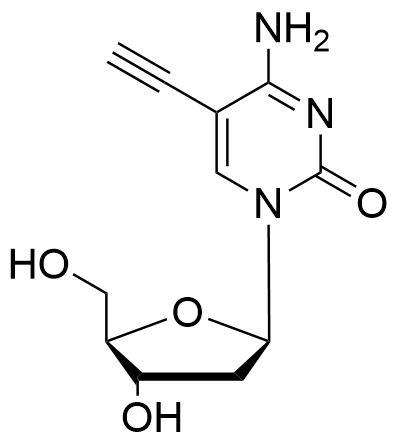
5-Ethynyl-2′-deoxycytidine (5-EdC)
Clickable EdC (EdU alternative) allows detection of de novo DNA
| Size | Catalog No. | Price |
|---|---|---|
| 50 mg | BCN-004-50 | € 90,00 |
| 100 mg | BCN-004-100 | € 160,00 |
| 500 mg | BCN-004-500 | € 490,00 |
Chemical Properties
-
Molecular Formula
C11H13N3O4
-
Shelf Life
12 months unopened after receipt
-
Storage Conditions
-20 °C, dry
-
Molecular Weight
251.24 g/mol
-
Purity
≥ 98% (HPLC)
-
Physical State
white to yellow solid
-
CAS Number
69075-47-4
-
Additional name
EdC
-
Solubility
DMSO, PBS
Product Information
Fast and Sensitive de novo DNA Labeling Without a Denaturation Step
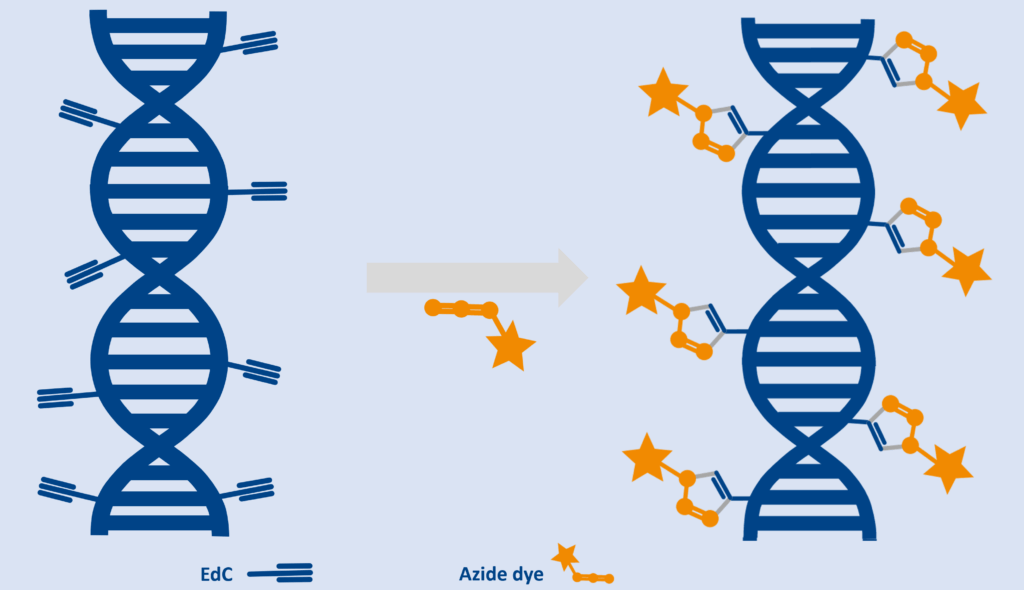
5‑EdC is a cell-permeable cytidine analogue incorporated into DNA during S‑phase of the cell cycle instead of the natural nucleobase. Using copper‑catalyzed azide–alkyne cycloaddition (CuAAC) “click chemistry”, de novo synthesized EdC-labeled DNA can be fluorescently tagged without denaturing the DNA, providing clear signals for:
- fluorescence microscopy
- flow cytometry
- high-throughput screening
This method is faster and gentler than BrdU. The workflow of 5-ethynyl-deoxycytidine is similar to its more known analog EdU and is an alternative to it if the use of a thymidine analog is undesirable.
Why buy 5-EdC from baseclick?
- Market‑leading pricing with bulk options, consistent ≥ 95% HPLC purity, and rapid, reliable supply for screening and routine proliferation assays.
- Available Sizes: 50 mg, 100 mg, 500 mg. Bulk quantities upon request (research use only; not for diagnostic procedures).
What makes 5-EdC different from other options?
EdC offers all the advantages of EdU compared to traditional methods (BrdU, ³H-thymidine) and is recommended for high labeling concentrations due to lower cytotoxicity than EdU.
Key Benefits:
- Click‑chemistry detection (CuAAC): Rapid, efficient dye conjugation to the ethynyl handle—recognized in the 2022 Nobel Prize in Chemistry—for high sensitivity and clean backgrounds [1].
- No DNA denaturation: Preserves cell morphology and antigenicity—ideal for multiplexing with immunostaining.
- High signal‑to‑noise ratio: Strong, uniform signals enable robust quantification across fluorescence microscopy, flow cytometry, and HCS/HCA.
- Broad compatibility: Works with mammalian cells, organoids, and tissue sections; supports in vitro and in vivo research workflows [2].
Please note: baseclick is not providing kit solutions for cell proliferation detection based on EdC but for all our cell proliferation detection kits EdU can be replaced with EdC. If you have any questions do not hesitate to contact our experts (support@baseclick.eu).
How does 5-ethynyl-2′-deoxycytidine (EdC) work?
Cell‑permeable 5‑EdC is converted intracellularly to the triphosphate and incorporated into newly synthesized DNA, replacing thymidine. The ethynyl group then reacts with azide‑modified fluorophores via CuAAC, generating bright nuclear labeling that marks actively proliferating cells with high specificity and spatial resolution [1, 2]. EdC can hydrolyze to EdU. This process is catalyzed by the enzyme cytidine deaminase, and the rates are strongly dependent on the organism. Therefore, your positive results while working with EdC are always at least a mixture of EdC and EdU incorporation into de novo synthesized DNA.
Key Features and application
- Cell proliferation assays (S-phase labeling)
- Cancer biology & cell cycle studies
- Drug screening & toxicity profiling
- Developmental biology and tissue kinetics
- Stem cell expansion and tracking
EdC is a HSV-1 inhibitor
5′-Ethynyl-2′-deoxycytidine (EdC) is also able to be used as a nucleotide analog to effectively inhibit the replication of the herpes simplex virus-1 (HSV-1) Kos strain.
LITERATURE
[1] A Stepwise Huisgen Cycloaddition Process: Copper(I)-Catalyzed Regioselective “Ligation” of Azides and Terminal Alkynes. V. Rostovtsev et al., Angew. Chemie Int. Ed. 2002, 41, 2596–2599.
https://doi.org/10.1002/1521-3773(20020715)41:14<2596::AID-ANIE2596>3.0.CO;2-4
[2] 5-Ethynyl-2′-deoxycytidine as a new agent for DNA labeling: detection of proliferating cells. Qu, D., et al. 2011. Anal Biochem. 417: 112-21. PMID: 21683679
https://pubmed.ncbi.nlm.nih.gov/21683679/#&dopt=Abstract
FAQ
-
Why is EdC better than BrdU?
EdC detection is antibody‑free and does not require DNA denaturation, preserving epitopes for co‑staining and delivering faster, cleaner readouts.
-
Which readouts are supported?
Fluorescence microscopy, flow cytometry, high‑content imaging; compatible with multiplex immunostaining.
-
Advantages of EdC compared to EdU?
EdC has lower cell toxicity in comparison to EdU in most organisms depending on the hydrolysis rate. Therefore, if working with high ethynyl nucleotide concentration or long pulse times is considered, EdC should be the nucleotide of choice for your experiments. At commonly used concentrations and pulse times, EdU is well‑tolerated in standard cell systems.