


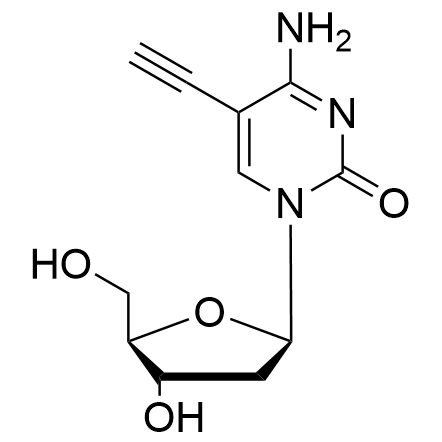
5-Ethynyl-2′-deoxycytidine (5-EdC)
Clickable EdC (EdU alternative) allows detection of de novo DNA
| Size | Catalog No. | Price |
|---|---|---|
| 50 mg | BCN-004-50 | € 90,00 |
| 100 mg | BCN-004-100 | € 160,00 |
| 500 mg | BCN-004-500 | € 490,00 |
Chemical Properties
-
Molecular Formula
C11H13N3O4
-
Shelf Life
12 months unopened after receipt
-
Storage Conditions
-20 °C, dry
-
Molecular Weight
251.24 g/mol
-
Purity
≥ 98% (HPLC)
-
Physical State
white to yellow solid
-
CAS Number
69075-47-4
-
Additional name
EdC
-
Solubility
DMSO, PBS
Product Information
Fast and Sensitive de novo DNA Labeling Without a Denaturation Step
5‑Ethynyl‑2′‑deoxycytidine (EdC) is a synthetic nucleoside analog of 2′‑deoxycytidine. It carries a terminal ethynyl group at the 5‑position of the pyrimidine base.
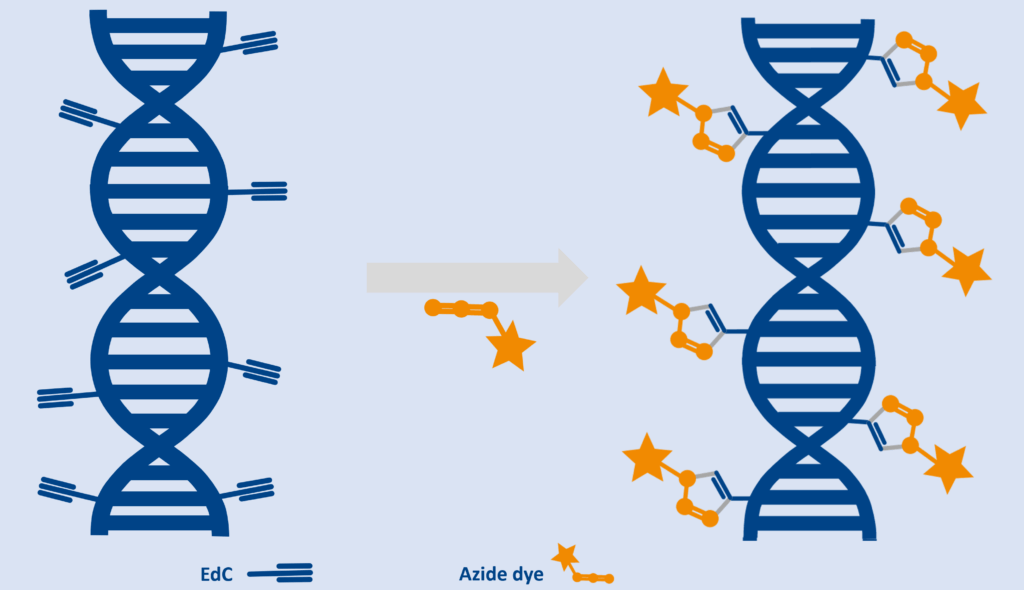
As a result, EdC allows fast and specific labeling of newly synthesized DNA via copper(I)‑catalyzed azide‑alkyne cycloaddition (CuAAC) chemistry.
Why buy 5-EdC from baseclick?
- Market‑leading pricing with bulk options, consistent ≥ 95% HPLC purity, and rapid, reliable supply for screening and routine proliferation assays.
- Available Sizes: 50 mg, 100 mg, 500 mg. Bulk quantities upon request (research use only; not for diagnostic procedures).
Key Features
- Efficient DNA labeling through cellular metabolism: EdC enters cells through nucleoside transporters and is then metabolically processed before it becomes incorporated into replicating DNA.
- Flexible detection options: The ethynyl group reacts with azide‑modified dyes or affinity tags such as biotin. Therefore, EdC supports both imaging and enrichment workflows.
- No DNA denaturation required: In contrast to BrdU assays, click chemistry allows detection without harsh denaturation steps. This helps preserve cell structure and antigenicity.
- Cytidine‑based alternative to EdU: Unlike EdU, EdC follows a cytidine pathway. Therefore, it provides an alternative strategy when thymidine analogs are not suitable or affect the system
Please note: baseclick is not providing kit solutions for cell proliferation detection based on EdC but for all our cell proliferation detection kits EdU can be replaced with EdC. If you have any questions do not hesitate to contact our experts (support@baseclick.eu).
Main Applications of EdC
- Monitoring DNA synthesis and cell proliferation
- Cell cycle analysis (S‑phase labeling)
- Fluorescence microscopy and flow cytometry
- High‑content screening
- Analysis of nucleoside metabolism and enzyme activity
What makes EdC different from EdU?
EdC differs fundamentally from EdU in its intracellular processing:
- Metabolic conversion step: EdC is enzymatically converted to EdU via cytidine deaminases before incorporation into DNA.
- Cell‑dependent incorporation efficiency: The labeling efficiency of EdC depends on cellular enzyme activity (e.g., cytidine deaminase and kinases), leading to cell‑type‑specific incorporation behavior.
- Lower direct incorporation in short pulses: Compared to EdU, EdC can show lower incorporation during short labeling times, reflecting its additional metabolic step.(3)
- Reduced cytotoxicity in longer experiments: EdC is often preferred for extended incubations, as EdU can exhibit increased cytotoxicity under these conditions.
EdC is a HSV-1 inhibitor
5′-Ethynyl-2′-deoxycytidine (EdC) is also able to be used as a nucleotide analog to effectively inhibit the replication of the herpes simplex virus-1 (HSV-1) Kos strain.
Literature
[1] A Stepwise Huisgen Cycloaddition Process: Copper(I)-Catalyzed Regioselective “Ligation” of Azides and Terminal Alkynes. V. Rostovtsev et al., Angew. Chemie Int. Ed. 2002, 41, 2596–2599.
https://doi.org/10.1002/1521-3773(20020715)41:14<2596::AID-ANIE2596>3.0.CO;2-4
[2] 5-Ethynyl-2′-deoxycytidine as a new agent for DNA labeling: detection of proliferating cells. Qu, D., et al. 2011. Anal Biochem. 417: 112-21. PMID: 21683679
https://pubmed.ncbi.nlm.nih.gov/21683679/#&dopt=Abstract
[3] 5-Ethynyl-2′-deoxycytidine and 5-ethynyl-2′-deoxyuridine are differentially incorporated in cells infected with HSV-1, HCMV, and KSHV viruses. Salomé Manska., et al. 2020. Journal of Biological Chemistry, Volume 295, Issue 18
https://www.sciencedirect.com/science/article/pii/S0021925817482226
FAQ
-
Why is EdC better than BrdU?
EdC detection is antibody‑free and does not require DNA denaturation, preserving epitopes for co‑staining and delivering faster, cleaner readouts.
-
Which readouts are supported?
Fluorescence microscopy, flow cytometry, high‑content imaging; compatible with multiplex immunostaining.
-
Advantages of EdC compared to EdU?
EdC has lower cell toxicity in comparison to EdU in most organisms depending on the hydrolysis rate. Therefore, if working with high ethynyl nucleotide concentration or long pulse times is considered, EdC should be the nucleotide of choice for your experiments. At commonly used concentrations and pulse times, EdU is well‑tolerated in standard cell systems.