


Cu-Reactor
solid copper catalyst in high quality for optimal yield
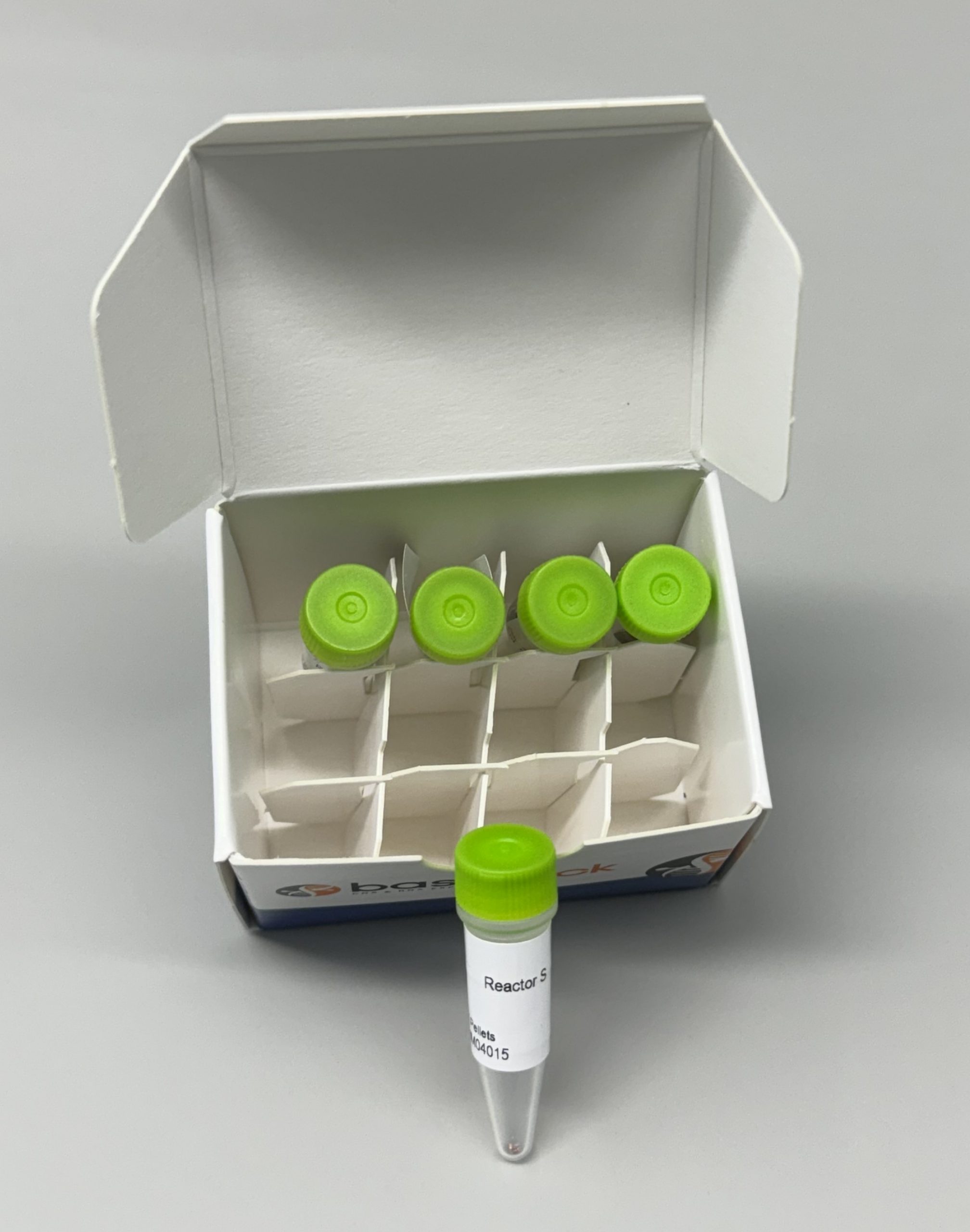
| Size | Catalog No. | Price |
|---|---|---|
| 5 x S (3 Pellets) | BCMI-009-Sx5 | € 65,00 |
| 10 x S (3 Pellets) | BCMI-009-Sx10 | € 100,00 |
| 5 x L (12 Pellets) | BCMI-009-Lx5 | € 80,00 |
| 10 x L (12 Pellets) | BCMI-009-Lx10 | € 130,00 |
Chemical Properties
-
Molecular Formula
Cu
-
Shelf Life
12 months unopened after receipt
-
Storage Conditions
RT, dry
-
Purity
≥ 99% (ICP-OES)
-
Physical State
copper colored solid
-
CAS Number
7440-50-8
-
Solubility
unsoluble solid catalyst
Product Information
Cu-Reactor: Solid Copper Catalyst for Click Chemistry (CuAAC)
Innovative heterogeneous copper source for biomolecule-friendly click reactions
The solid Cu-Reactor is an innovative alternative copper source designed to facilitate the copper-catalyzed alkine-azide cycloaddition (CuAAC). The CuAAC reaction was the first descript reaction meeting the criteria for “Click Chemistry” and remains the most widely used click reaction to date.
baseclick developed the Cu-Reactor as a heterogenous catalyst to provide an alternative to common soluble copper sources, namely CuBr and CuSO4.
Key Advantages of the Cu-Reactor
- Minimal concentration of copper ions: Since solid Cu-reactor is not dissolved during the reaction, the concentration of copper ions is very low making it an ideal choice for performing click reactions on copper sensitive biomolecules like RNA.
- Easy purification: As every heterogenous catalyst, the Cu-reactor can be easily removed from the reaction mixture by simple physical separation, eliminating the need for the complex purification steps typically required with soluble copper catalysts.
- Easy reaction setup: The Cu-reactor is supplied in a 1.5 mL Vial with an ideal shape to perform click reactions in small volumes. After adding the alkyne- and azide-containing reaction partners, as well as a copper-chelating ligand, the reaction can be started by placing the vial in a Thermomixer.
The Cu-Reactor was originally developed as part of baseclick´s method for linking oligonucleotides via click chemistry. This technique enables the creation of longer templates for PCR, evading the limitations in Oligonucleotides lengths by solid phase synthesis.[1] This solution can also be purchased as an Oligo Link Kit. Besides the Cu-Reactor this kit also provides a special Activator for even better reaction performance.
The Activator contains among others a copper chelating ligand, namely THPTA, to prevent copper catalyzing side reactions. Such a ligand should also be used when performing CuAAC reactions without the Activator.
To optimize the performance of your reactions, baseclick provides a protocol for the setup of click reactions using CuAAC in a solid reactor. Please be aware that this protocol is only meant as a starting point. For using different concentrations or reaction partners as mentioned in the protocol, please consider adjusting the conditions accordingly to obtain the optimal reaction outcome.
LITERATURE
[1] Efficient DNA click reaction replaces enzymatic ligation. Kollaschinski, M. et al, 2019. Bioconjugate Chemistry, 31(3), 507-512.
https://pubs.acs.org/doi/abs/10.1021/acs.bioconjchem.9b00805
FAQ
-
Which reagents to avoid in copper catalyzed click reactions?
Some biochemical buffer components can interfere with the copper-catalyzed click reactions (CuAAC). For example, TE and TAE buffer contain EDTA which chelates the copper ions and thus decreases reaction kinetic and yield. Moreover, free thiols, as dithiothreitol (DTT) and mercapto ethanol, can deteriorate or completely prevent click reactions.
-
What kind of labels can be clicked?
As it is the nature of click reactions, various groups can be attached to nucleic acids, not constricted to dyes. The only requirement is the use of high quality reagents containing clickable groups.