


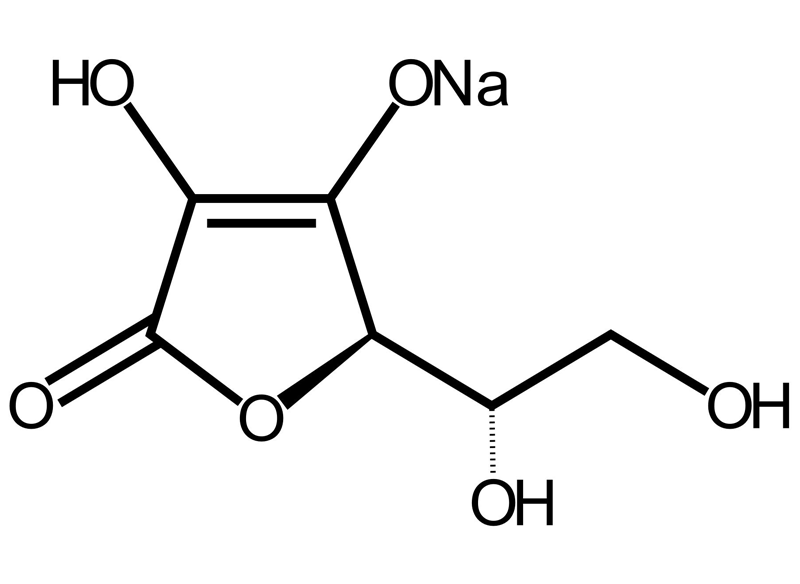
Na-Ascorbate
"baseclick-grade" reducing agent for optimal click reaction
| Size | Catalog No. | Price |
|---|---|---|
| 5 x 10 mg | BCMI-005-10x5 | € 45,00 |
| 10 x 10 mg | BCMI-005-10x10 | € 75,00 |
Chemical Properties
-
Molecular Formula
C6H7NaO6
-
Shelf Life
12 months unopened after receipt
-
Storage Conditions
2-8 °C, store dry
-
Molecular Weight
198.11 g/mol
-
Purity
≥ 99% (iodometric)
-
Physical State
white to slightly yellow crystals
-
CAS Number
134-03-2
-
Additional name
Sodium Ascorbate
-
Solubility
aqueous solution
-
Preparation/Handling
Used as reducing agent for Copper(II) sulfate (CuSO4) to perform click reactions in aqueous media
Product Information
High purity, reliable performance, optimized for CuAAC in sensitive biomolecule applications
Na-ascorbate, the sodium salt of ascorbic acid, is the most commonly used reducing agent for performing the copper catalyzed alkyne-azide cycloaddition (CuAAC) with CuSO4. The CuAAC reaction was the first reaction to meet the criteria for “Click Chemistry” and remains the most widely used click reaction today.
Na-ascorbate is needed to reduce the Cu(II) in CuSO4 to the catalytic active Cu(I) species necessary for catalyzing the click reaction. This system is ideal for aqueous CuAAC reactions, especially with water-soluble biomolecules in cell culture experiments or with sensitive biomolecules that cannot tolerate organic solvents such as DMSO.
To prevent copper from catalyzing unwanted side reactions, the use of a copper-chelating ligand (e.g., THPTA) is highly recommended. For optimal results, use high-purity reagents such as those provided and tested by baseclick.
CuAAC Reaction Optimization
To optimize the performance of your reactions, baseclick provides several protocols for the setup of click reactions using CuAAC, including Na-ascorbate activated CuSO4 reaction protocols as for mRNA labeling, or Oligo labeling. These protocols serve as starting points, adjust conditions as needed for different concentrations or reaction partners.
Handling & Storage
- Prepare Na-ascorbate solutions fresh for best results.
- Stock solutions can be stored at –20 °C and diluted before use.
- Do not use solutions that have turned brownish.
Important: Avoid EDTA-containing buffers and DEPC-treated water, as they chelate copper and inhibit the reaction. Use double-distilled water (ddH₂O) or HPLC-grade water instead.
LITERATURE
Rostovtsev, V. V., et al. (2002). A Stepwise Huisgen Cycloaddition Process: Copper(I)-Catalyzed Regioselective “Ligation” of Azides and Terminal Alkynes. Angewandte Chemie International Edition, 41(14), 2596–2599.
https://doi.org/10.1002/1521-3773(20020715)41:14%3C2596::aid-anie2596%3E3.0.co;2-4
Kolb, H. C., Finn, M. G., & Sharpless, K. B. (2001). Click Chemistry: Diverse Chemical Function from a Few Good Reactions. Angewandte Chemie International Edition, 40(11), 2004–2021.
Hong, V., et al. (2009). Analysis and Optimization of Copper-Catalyzed Azide–Alkyne Cycloaddition for Bioconjugation. Bioconjugate Chemistry, 20(2), 333–338
https://doi.org/10.1002/anie.200905087
Functionalization of the surface of electrospun poly(epsilon-caprolactone) mats using zwitterionic poly(carboxybetaine methacrylate) and cell-specific peptide for endothelial progenitor cells capture, Q. Li et al., 2013, Mater. Sci. Eng., Vol. 33(3), p. 1646-1653.
https://doi.org/10.1016/j.msec.2012.12.074
Synthesis of in situ functionalized iron oxide nanoparticles presenting alkyne groups via a continuous process using near-critical and supercritical water, M. D. de Tercero, 2013, J Supercrit Fluids, Vol. 82, p. 83-95.
https://doi.org/10.1016/j.supflu.2013.06.006
FAQ
-
What is the role of Na-ascorbate in CuAAC click chemistry?
Na-ascorbate acts as a reducing agent, converting Cu(II) from CuSO₄ into the catalytically active Cu(I) species required for the copper-catalyzed alkyne–azide cycloaddition (CuAAC).
-
Why is Na-ascorbate preferred for aqueous CuAAC reactions?
It enables efficient click reactions in water-based systems, making it ideal for biomolecules, cell culture experiments, and sensitive samples that cannot tolerate organic solvents like DMSO.
-
Do I need a copper-chelating ligand?
Yes. To prevent unwanted side reactions, use a water-soluble ligand such as THPTA along with Na-ascorbate and CuSO₄ for optimal performance.
-
How should Na-ascorbate solutions be prepared and stored?
Prepare fresh solutions for best results. Stock solutions can be stored at –20 °C and diluted before use. Discard any solution that turns brownish.
-
Which buffers and water types should I avoid?
Avoid EDTA-containing buffers and DEPC-treated water, as they chelate copper and inhibit the reaction. Use double-distilled water (ddH₂O) or HPLC-grade water instead.
-
Does baseclick provide protocols for CuAAC reactions?
Yes. We offer optimized protocols for applications such as mRNA labeling and oligonucleotide labeling using Na-ascorbate activated CuSO₄ systems.